Qi Men Dun Jia for Beginners: What It Is, How to Read a Chart, What to Learn First
What is Qi Men Dun Jia? One of the Three Arts of Chinese divination, it casts a nine-palace chart for a moment in time to read a specific matter. Learn to recognise every symbol on a real chart from this site, and the order to study in.
Qi Men Dun Jia casts a nine-palace chart for the moment a question is asked and reads a specific matter from the stars, gates, deities and stems on it. Learn to recognise the chart first, then the ten stems and their combinations, then how to ask a question, pick the key symbol and tell host from guest, and only then the main lines, timing and directions.
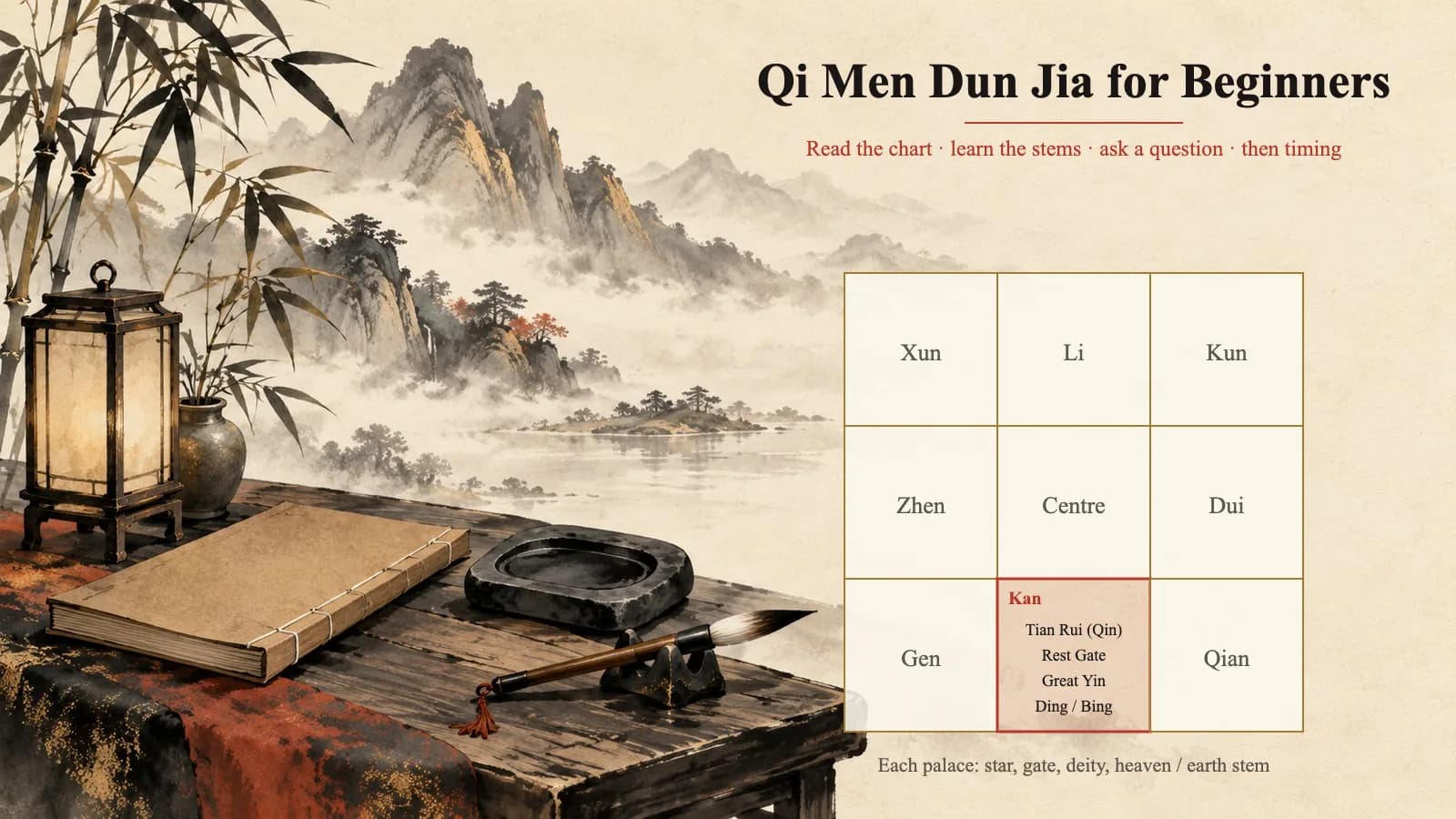
Qi Men Dun Jia (奇门遁甲) is one of the "Three Arts" (三式) of classical Chinese divination, alongside Tai Yi and Liu Ren. It casts a nine-palace chart for a single moment and places four kinds of symbols on it: the nine stars for heavenly timing, the eight gates for human affairs, the eight deities for help and hindrance, and the ten Heavenly Stems. Together they are used to read one specific matter: what the situation is, who has the upper hand, where it is stuck, and when it may change. The order for learning it is simple: learn to recognise the chart, then the stems and their combinations, then how to ask about a matter, and only after that the deeper methods.
Is Qi Men Dun Jia fortune telling?
Not exactly. Its most common use is reading a question: you cast a chart for the moment a question is asked, or the moment something happened, and read where that matter is heading. There is also a lifetime chart (终身局) cast from a birth time to read the stages of a life, but that is a different use. Beginners often confuse the two; the difference is explained in Qimen destiny chart vs hour chart.
Nor is Qi Men a single verdict of "good" or "bad". A chart offers the shape of a situation, the balance of forces and clues about timing. It cannot read another person's private thoughts, and it does not make real decisions for you. How to check whether readings hold up is covered in Is Qi Men Dun Jia accurate?.
Step 1: Recognise five things on the chart
Do not start by casting charts by hand. Solar terms, the bureau number (ju) and the ten-day leader are easy to get wrong, so let a calculator cast the chart and spend your effort on reading it. The chart below is calculated live by this site's chart component for 10:00 Beijing time on 24 October 2026; you can click any palace. You can also open the same chart in the calculator.
Useful God (Yong Shen) lookup
Career · Open Gate
On this chart, find these five things:
| What to find | Where to look | On this chart |
|---|---|---|
| The header: time, solar term, bureau | Above the grid | Pillars Bing Wu, Wu Xu, Xin Wei, Gui Si; Frost Descent, Yin Dun Ju 8 |
| The nine palaces and their directions | The nine cells, with the centre palace in the middle | Each outer palace stands for a direction, for example Kan is north and Li is south |
| The four layers in each palace | The star, gate, deity, heaven-plate stem and earth-plate stem in each cell | Kan: Tian Rui (carrying Tian Qin), Rest Gate, Great Yin, heaven stem Ding (plus Xin lodged on the heaven plate), earth stem Bing |
| The Chief star and Chief gate | "Chief" entries in the header | Tian Xin is in Zhen; the Open Gate is in Qian |
| Void | The "Void" row under the pillars | The hour Void is Wu and Wei, in Li and Kun |
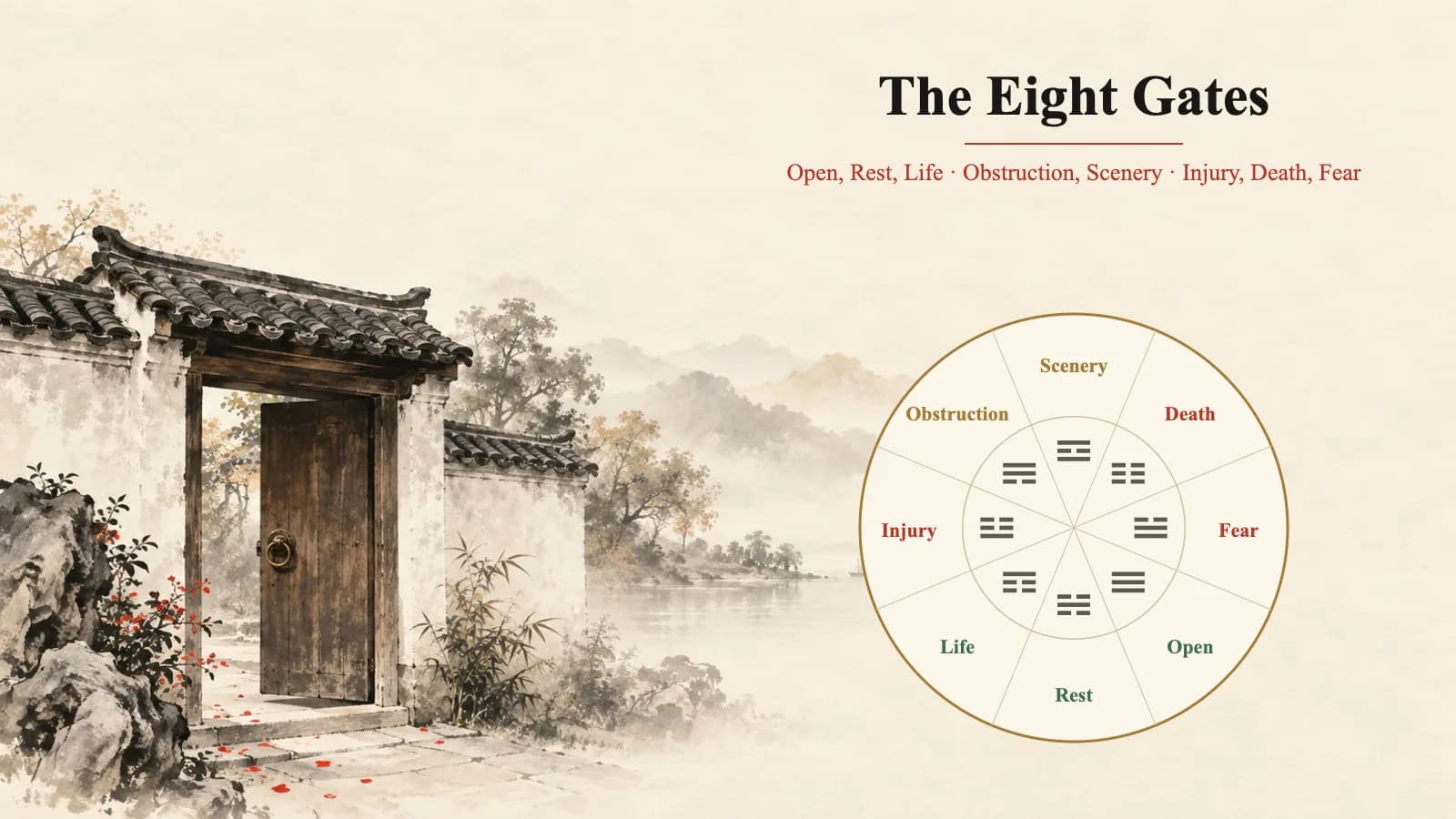
Each family has fixed members. The nine stars are Tian Peng, Tian Rui, Tian Chong, Tian Fu, Tian Qin, Tian Xin, Tian Zhu, Tian Ren and Tian Ying. The eight gates are Rest, Life, Injury, Obstruction, Scenery, Death, Fear and Open. The eight deities are Chief, Soaring Snake, Great Yin, Six Harmony, White Tiger, Black Tortoise, Nine Earth and Nine Heaven. Look up any symbol in the Qimen glossary; the gates and their directions are explained in the eight gates of Qi Men Dun Jia, and the Chief star and gate in what Zhifu and Zhishi mean.
The goal of this step is only to look at any cell and name everything in it. No judgement yet.
Step 2: Learn the ten stems and their combinations
Every palace holds a heaven-plate stem over an earth-plate stem. Each pairing has a traditional name and meaning, known as the ten-stem responses (十干克应) or patterns; Wu over Bing and Bing over Wu, for example, are two well-known ones with different meanings. The San Yuan school course this site follows also begins with the patterns of the ten stems, because almost every later judgement depends on them.
Classical verse helps here. The Yanbo Diaosou Ge (《烟波钓叟歌》) is the most quoted Qi Men rhyme, and this site has a line-by-line plain-language reading. Do not memorise good and bad labels; learn what kind of person or matter each stem stands for and why a pairing means what it does.
Step 3: Learn how to read one matter
Only after you can read the chart does "reading a matter" begin. There are three basics:
- Ask a specific question. "How is my luck lately?" is hard to read; "Will I pass this interview?" is clear. See how to ask a Qimen question.
- Find the key symbol (yong shen). Different matters are read from different symbols; a job question, for example, looks at the Open Gate. See the pages on career questions and relationship questions.
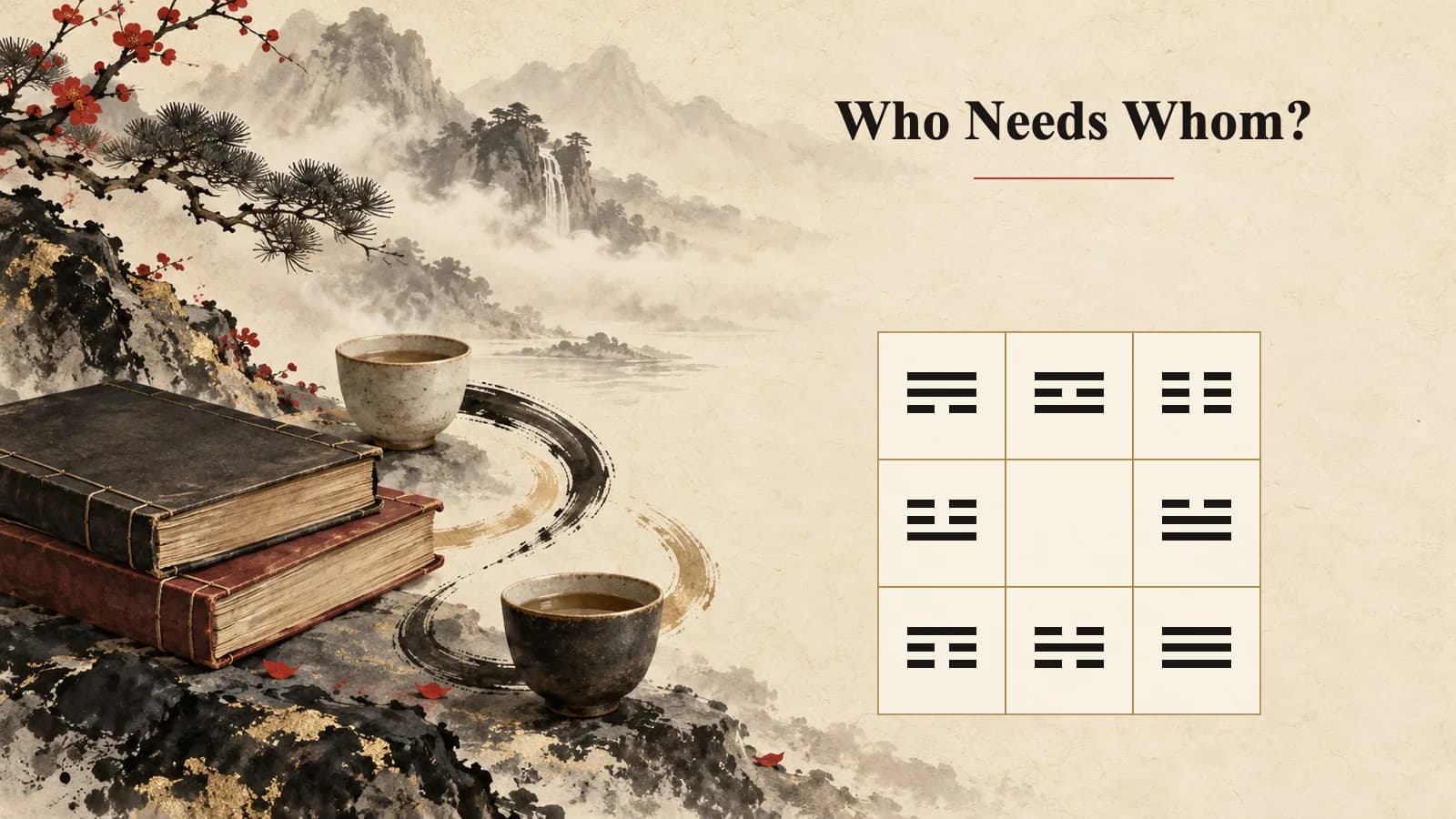
- Tell host from guest. By default this site takes the palace of the Day Stem as you and the palace of the Hour Stem as the other party or the matter. On the chart above, the Day Stem Xin is in Kan (it is the stem lodged on Kan's heaven plate) and the Hour Stem Gui is in Kun. How to compare two palaces is shown in who needs whom in Qi Men Dun Jia.
The full reading order is in how to read a Qimen chart.
Step 4: Then the main lines, timing and directions
With the first three steps in place, move on to the deeper methods:
- The San Yuan main lines. This site follows the San Yuan school, which reads three lines (yuan shen, yuan qi and tian yi) besides the key symbol and the two sides, to follow a matter from cause to present to outcome. See what is San Yuan Qimen.
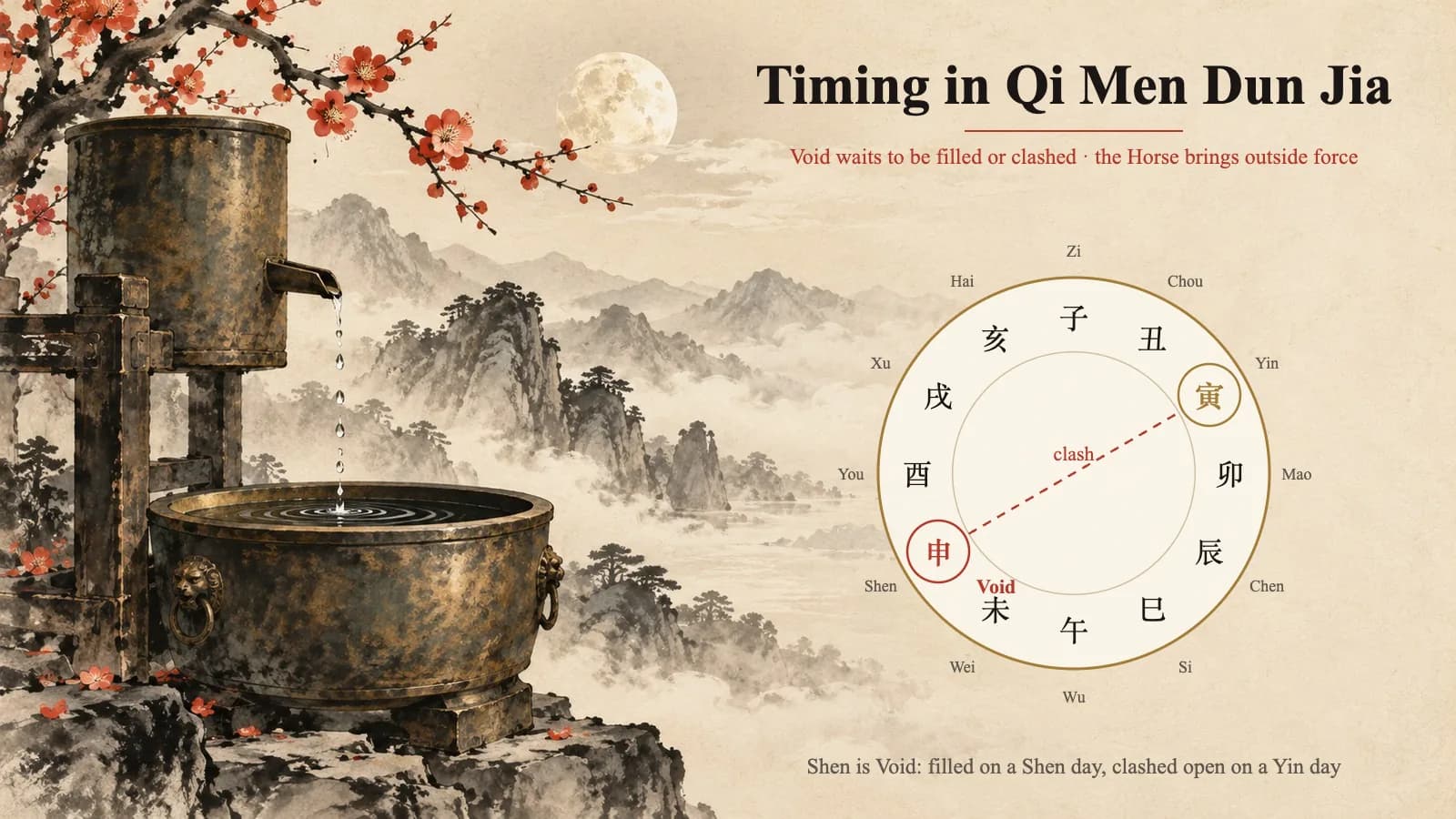
- Timing. Answering "when" uses Void, the Travel Horse and the natural length of the matter. See timing in Qi Men Dun Jia.
- Directions. For travel or a meeting, see where the three auspicious gates fall, in the direction finder and the Life Gate direction.
All of these rest on the basics. Looking for timing or directions before you can read the chart and pick the key symbol only produces confused answers.
Common beginner mistakes
- Reading one lucky gate or one bad pattern on its own. Do not judge a gate by its auspicious label alone; check its relationship to the key symbol and its condition on the chart. Likewise, check which palace a bad pattern sits in and whether it touches the matter.
- Casting again and again for the same matter. If nothing has changed, keep asking about the original chart instead of recasting until you get the answer you want.
- Panicking when two calculators disagree. Check the time standard, the day-change rule and the casting method first. See why Qimen calculators give different charts.
- Taking an AI answer as final. Before using AI, confirm the chart itself is correct. Common problems are in can AI cast a Qi Men Dun Jia chart?
Practising with this site
The easiest practice is to take something that has already happened, cast a chart for that time, and learn each symbol against the known outcome. The calculator needs no sign-in, and you can click any palace for an explanation. To see how a whole matter is read, try Dunyuan AI reading and check the chart evidence it cites for yourself.
FAQ
What is Qi Men Dun Jia?
It is one of the Three Arts of classical Chinese divination. It casts a nine-palace chart for a moment in time, with the nine stars, eight gates, eight deities and ten stems, and reads the situation, balance of forces and timing of a specific matter.
Is Qi Men Dun Jia fortune telling?
Its main use is reading specific questions rather than a person's fate. A lifetime chart cast from the birth time reads the stages of a life, but that is a different use from the hour chart for a question.
Do beginners need to cast charts by hand?
No. Use a calculator to get the chart right and spend your time on recognising symbols, the stems and reading. Casting by hand can wait until you understand solar terms, bureaus and the ten-day leader.
In what order should I study Qi Men Dun Jia?
First recognise the chart (palaces, stars, gates, deities, stems, the Chief star and gate, Void), then the ten stems and their combinations, then asking a question, the key symbol and the two sides, and finally the main lines, timing and directions.
What books are there for learning Qi Men Dun Jia?
The most quoted classical text is the Yanbo Diaosou Ge. The San Yuan system on this site draws on lineage works including San Yuan Qimen Mi Ce, Dun Jia Ji Zhang and Qi Men Dun Jia Sui Shi Lu.