The Eight Gates of Qi Men Dun Jia: Meanings, Elements and Directions
One table for the eight Qi Men gates—element, home direction, auspicious or not, and traditional uses—plus which palaces cause a gate clash, restraint, tomb, Fu Yin or Fan Yin.
The eight gates split into three auspicious gates (Open, Rest, Life), three inauspicious gates (Injury, Death, Fear) and two neutral ones (Obstruction, Scenery). Where a gate lands matters too: gate pressing palace, palace restraining gate and tomb all weaken it.
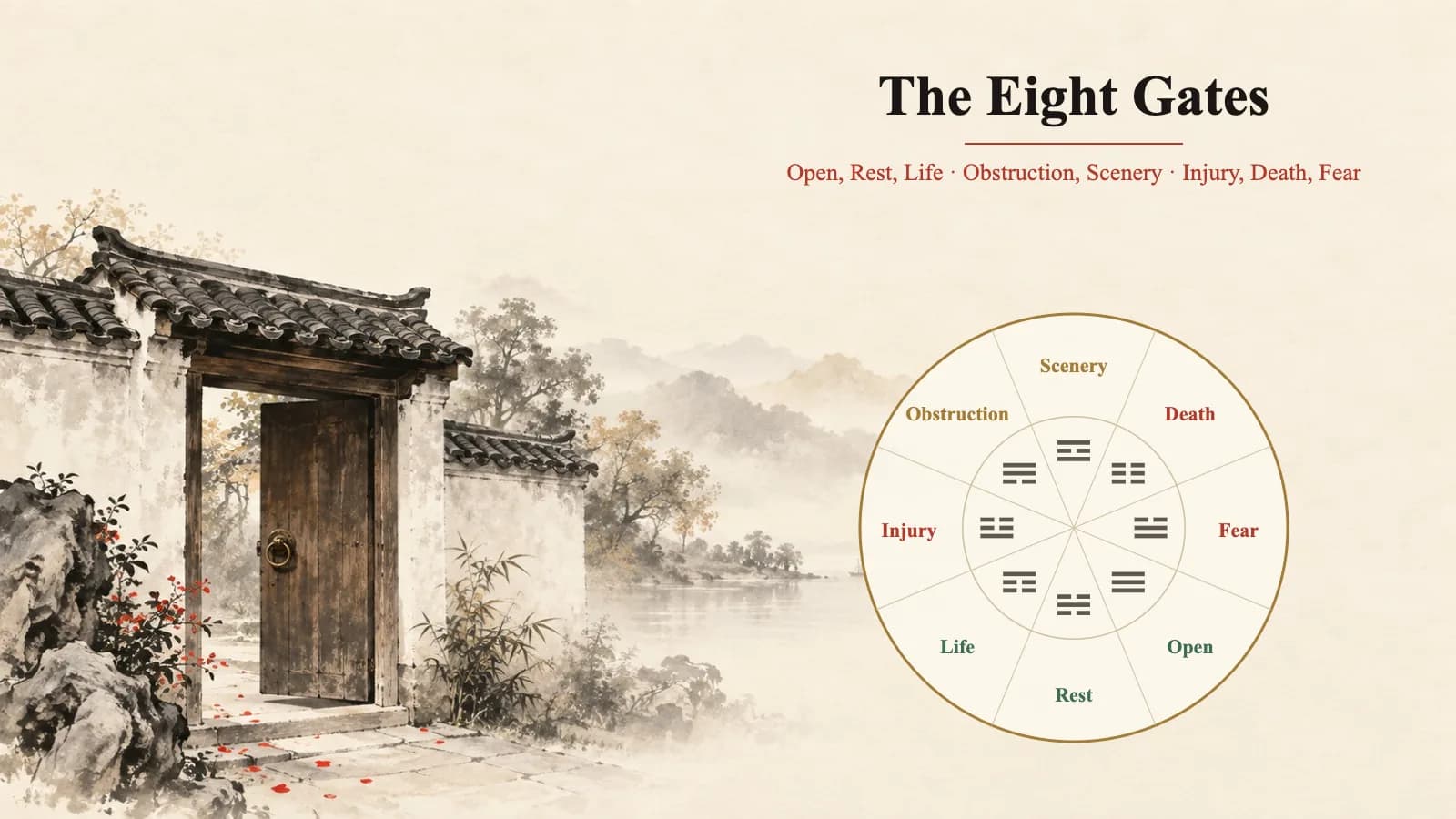
The eight gates (八门, sometimes translated as the eight doors) are the human layer of a Qi Men chart. A common summary is that the nine stars describe heaven's timing, the palaces describe the ground, and the gates describe human affairs. When you read a direction or a question, the gate is usually the first thing you look at. This article puts each gate's element, home direction, auspicious category and traditional use in one table, then explains why the palace a gate lands in can weaken even a good gate.
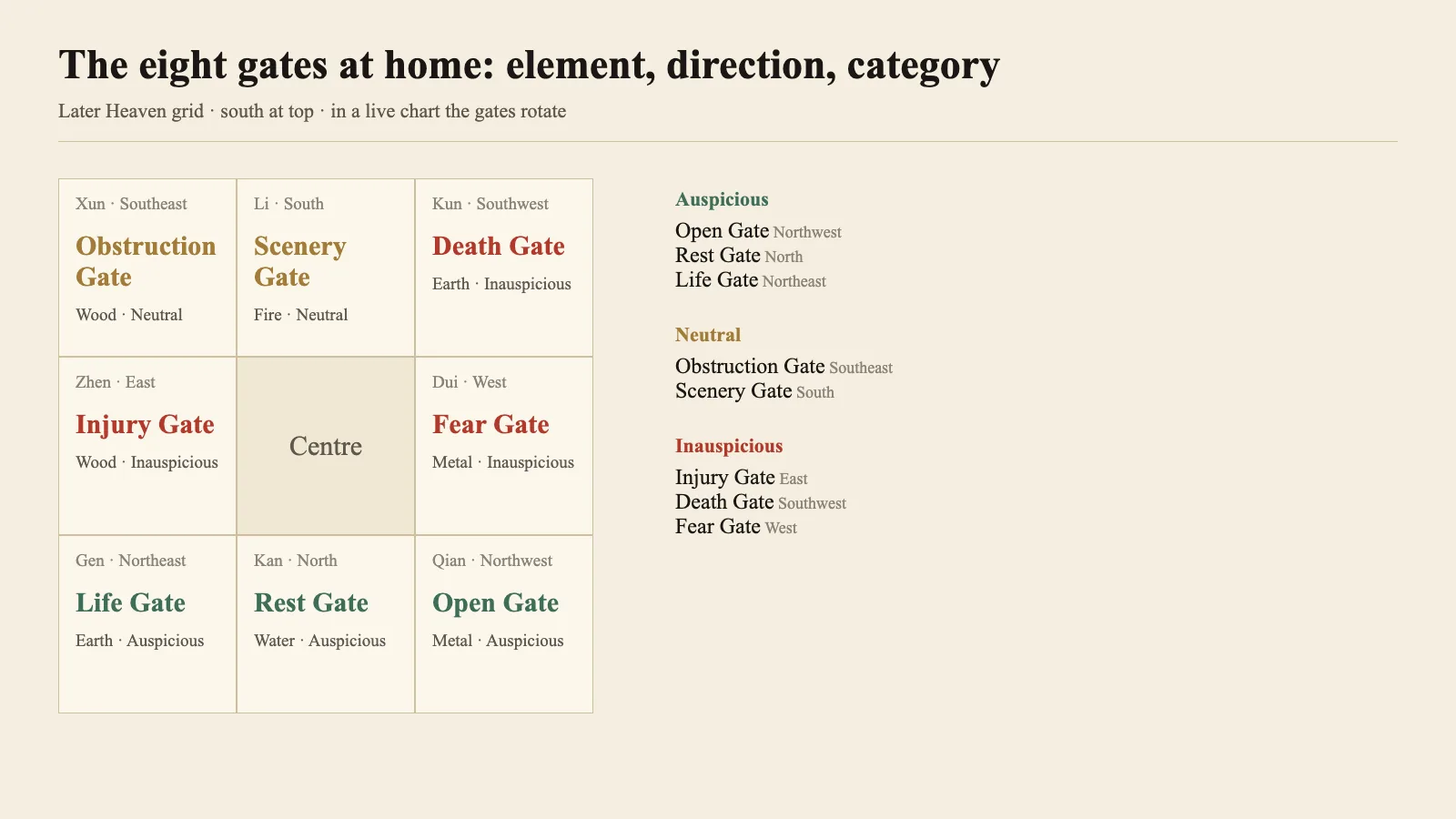
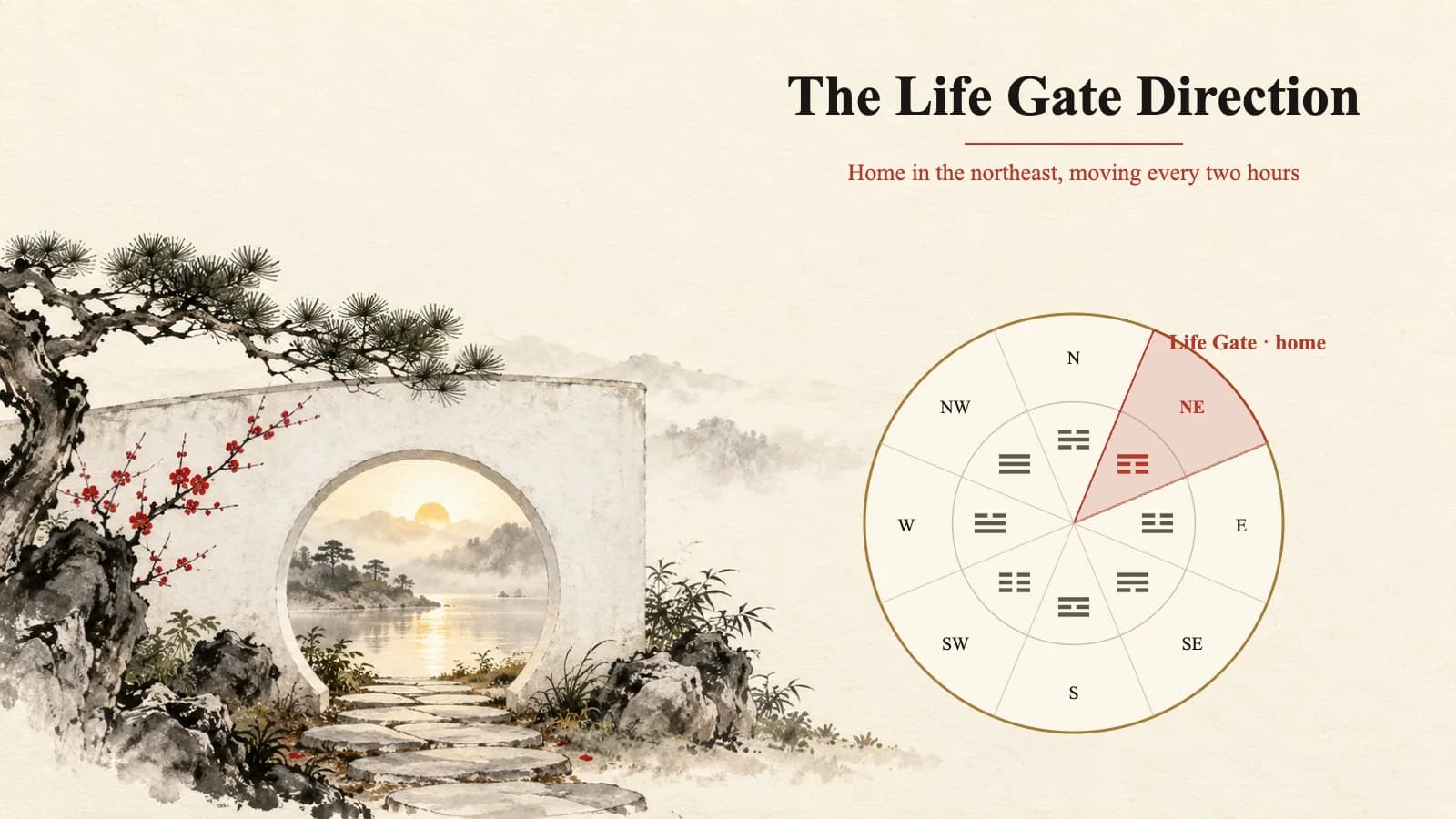
The gates' home positions on the Later Heaven grid, with south at the top as in a traditional chart. In a live hour chart the gates rotate with the Chief Gate.
The eight gates at a glance
| Gate | Element | Home palace and direction | Category | Traditionally used for |
|---|---|---|---|---|
| Open Gate (开门, Kai) | Metal | Qian · Northwest | Auspicious | Starting things, job hunting, meeting superiors, official business, formal negotiation |
| Rest Gate (休门, Xiu) | Water | Kan · North | Auspicious | Rest, repairing relationships, visiting elders, asking for help |
| Life Gate (生门, Sheng) | Earth | Gen · Northeast | Auspicious | Money, business, property, anything about returns |
| Injury Gate (伤门, Shang) | Wood | Zhen · East | Inauspicious | Competition, recovering debts; also injury and loss |
| Obstruction Gate (杜门, Du) | Wood | Xun · Southeast | Neutral | Hiding, avoiding, staying out of sight, focused technical work |
| Scenery Gate (景门, Jing) | Fire | Li · South | Neutral | Documents, exams, publicity, news; also show without substance |
| Death Gate (死门, Si) | Earth | Kun · Southwest | Inauspicious | Closing old matters, land and funerals; not used for auspicious aims |
| Fear Gate (惊门, Jing) | Metal | Dui · West | Inauspicious | Disputes, lawsuits, alarm; also unease |
The categories are tendencies, not verdicts. Inauspicious gates have their own uses: debt collection traditionally looks at the Injury Gate, quiet handling at the Obstruction Gate, and litigation at the Fear Gate. An auspicious gate in the wrong palace, on the other hand, may have little force.
Why the gates keep moving
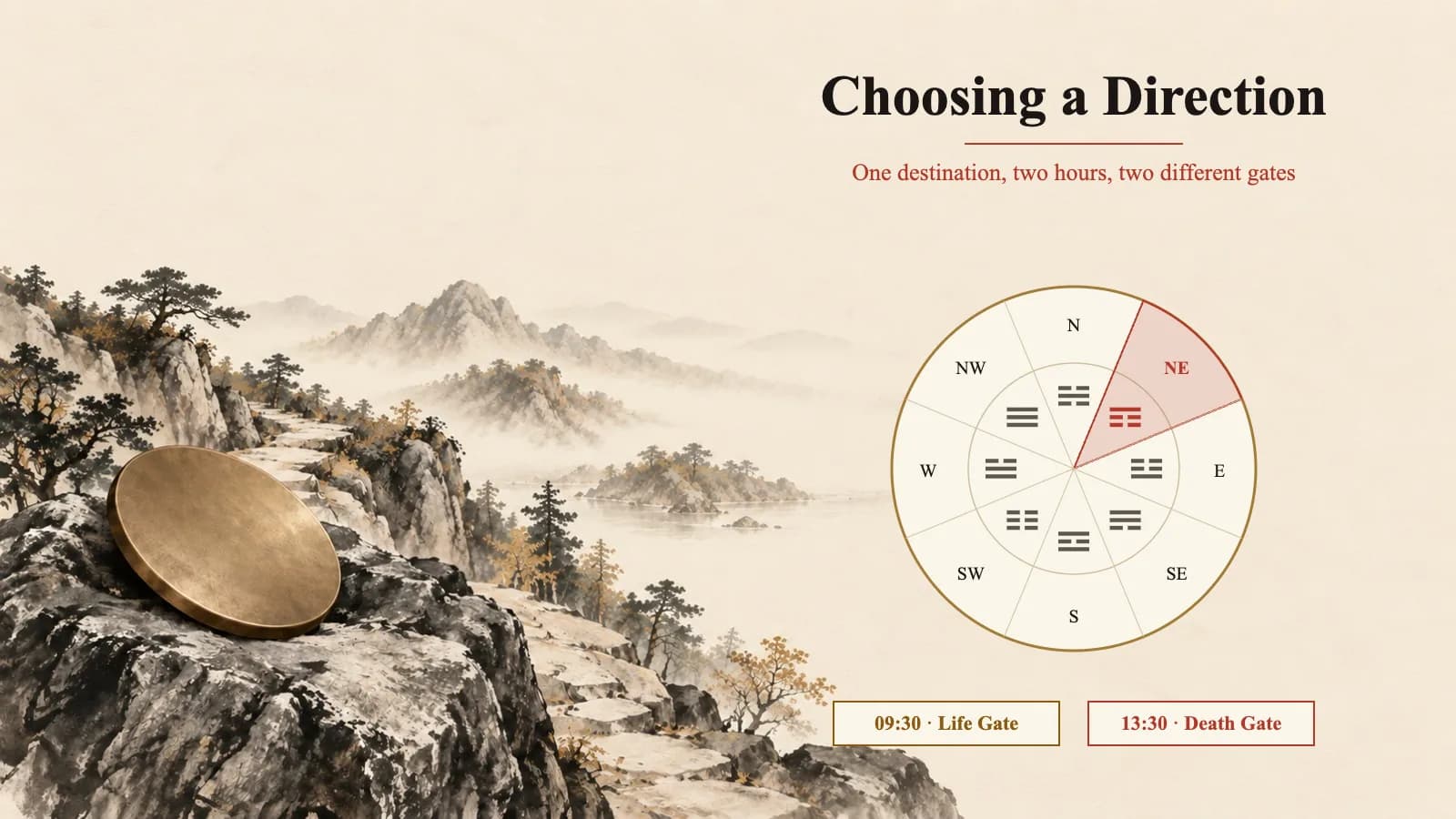
The home positions in the table are where each gate sits in the Later Heaven arrangement—what the chart looks like when the Chief Gate (值使) is "at home". This site uses the rotating-plate method: every hour the Chief Gate moves to a new palace and the ring of eight gates turns with it in a fixed order. The Open Gate's home is the northwest, but this morning it may be in the southeast and this afternoon in the north.
When a gate turns back to its home palace this is called Fu Yin; when it lands directly opposite, Fan Yin. Traditionally Fu Yin points to slow, steady progress and Fan Yin to reversals and back-and-forth movement. To see where the three auspicious gates are in each hour today, use the direction finder; why the gates follow the Chief Gate is covered in the Zhifu and Zhishi guide.
Gate and palace: pressing, restraint and tomb
Gates have elements, and so do palaces. Once a gate lands in a palace, the relationship between the two changes the gate's strength:
- Gate Pressures Palace (门迫): the gate's element controls the palace's, as when the Open Gate (Metal) lands in Zhen (Wood). Traditionally an auspicious gate in this position struggles to deliver.
- Palace Restrains Gate (宫迫): the palace's element controls the gate's, as when the Life Gate (Earth) lands in Zhen (Wood). The gate works at reduced strength.
- Gate in Tomb (门入墓): the gate sits in the tomb palace of its element, as when the Rest Gate (Water) lands in Xun, where Water's tomb lies. Its force is held back.
Under the site's rules, the gates behave like this in each palace:
| Gate | Gate Pressures Palace | Palace Restrains Gate | Gate in Tomb | Fu Yin (home) | Fan Yin (opposite) |
|---|---|---|---|---|---|
| Open | Zhen, Xun | Li | Gen | Qian | Xun |
| Rest | Li | Gen, Kun | Xun | Kan | Li |
| Life | Kan | Zhen, Xun | Xun | Gen | Kun |
| Injury | Gen, Kun | Dui, Qian | Kun | Zhen | Dui |
| Obstruction | Gen, Kun | Dui, Qian | Kun | Xun | Qian |
| Scenery | Dui, Qian | Kan | Qian | Li | Kan |
| Death | Kan | Zhen, Xun | Xun | Kun | Gen |
| Fear | Zhen, Xun | Li | Gen | Dui | Zhen |
A few patterns are easy to remember. The Life and Rest Gates both dislike Xun (the Life Gate is restrained and entombed there, the Rest Gate entombed). The Open Gate dislikes Zhen and Xun (east and southeast) and Li (south), and is entombed in Gen. The two Wood gates, Injury and Obstruction, share exactly the same problem palaces and differ only in their home. The direction finder shows Void, Gate Pressures Palace and Gate in Tomb in its table and the secondary marks in grey on its compass.
Reading gates by direction
For travel, gate reading reduces to three steps. First, see which directions hold the three auspicious gates. Second, see which gate sits in the direction of your destination and whether it carries Void, a gate clash or a tomb mark. Third, check whether the star and deity in that palace suit what you are doing.
If the destination direction holds Injury, Death or Fear, the simplest response is to pick another hour rather than force it. If it holds Obstruction or Scenery, think about the task: for quiet, private conversations the Obstruction Gate can actually suit; for announcements or handing in documents, the Scenery Gate fits better. A full decision is walked through in comparing two departure times with an hour chart.
Matching a gate to the task
Readers often treat a gate as "the door this matter goes through". The traditional pairings are roughly these: job hunting, promotion, meeting a superior or opening a business look to the Open Gate; asking for help, repairing a relationship or visiting elders look to the Rest Gate; pricing, collecting payment, investing or viewing property look to the Life Gate; exams, submissions, announcements and documents look to the Scenery Gate; confidential work, lying low or focused technical work look to the Obstruction Gate; debt collection and competition look to the Injury Gate; and disputes or lawsuits look to the Fear Gate.
Once you have the right gate, check where it lands. If you are heading to an interview and the Open Gate sits in Zhen, pressing its palace, that hour is not a smooth one for the interview. Later the same day the Open Gate may return to its home in the northwest, or land in Kun, where Earth feeds Metal; either is stronger. Gen is also Earth, but the Open Gate is entombed there, so it gains little.
What else to read beyond the gates
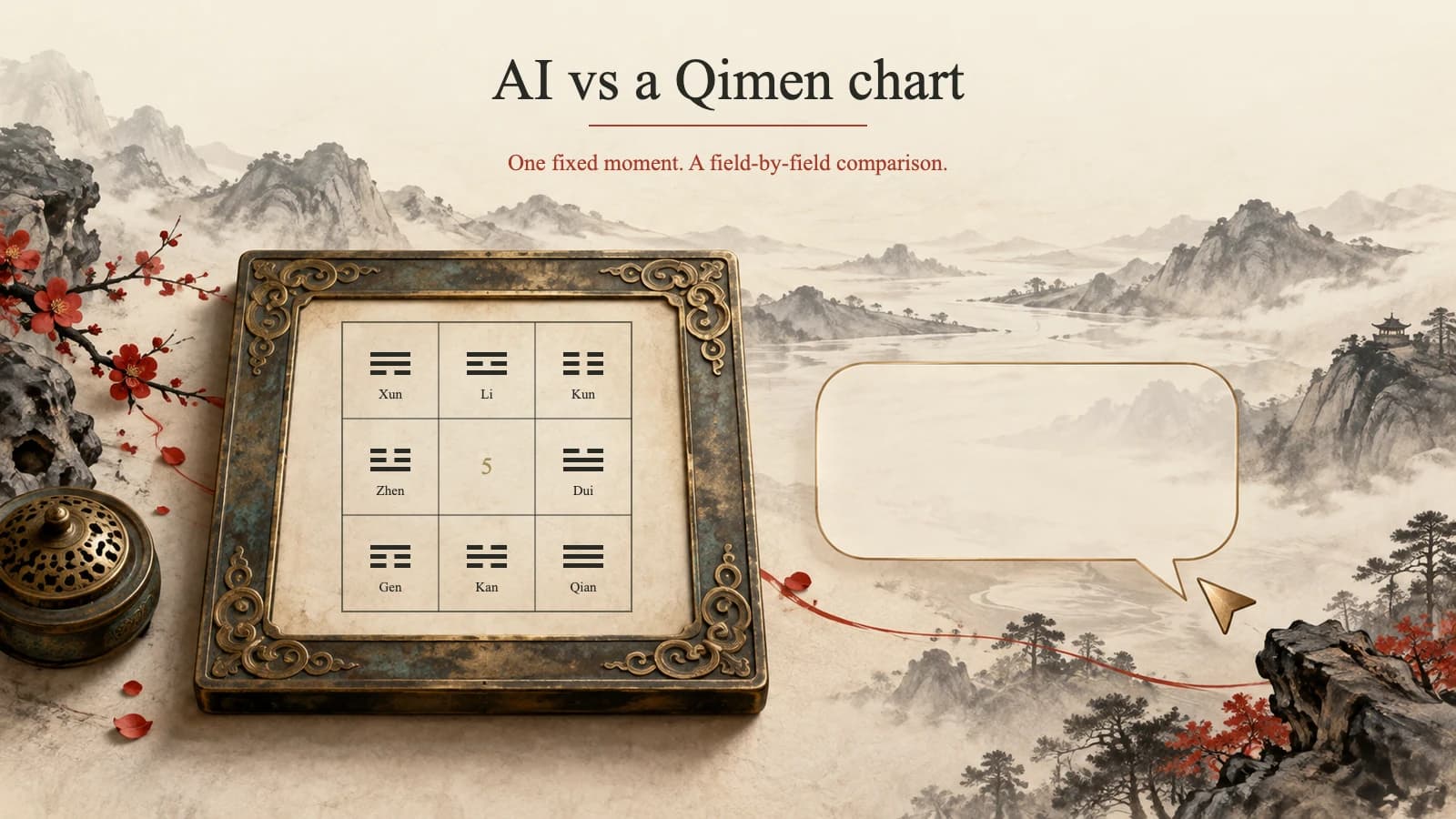
The gates are one layer. A full reading also weighs the nine stars for timing, the eight deities for help and hidden factors, the pattern formed by the heaven and earth stems, and which palaces represent you and the matter. The gate tells you whether the road is open; the other layers tell you what is on it. A Life Gate direction with the Chief deity reads very differently from one with the White Tiger.
To read a whole chart in order, see how to read a Qimen chart. If your main interest is money, start with the Life Gate direction.
FAQ
Which of the eight gates is the most auspicious?
The Open, Rest and Life Gates are the three auspicious gates, and none is best in every case. Career questions lean on the Open Gate, help and relationships on the Rest Gate, and money on the Life Gate—always checked against the palace it lands in.
Are the Obstruction and Scenery Gates good or bad?
They are usually treated as neutral. The Obstruction Gate suits hiding, avoiding and focused work; the Scenery Gate suits documents, exams and publicity. Used for the right task they help; used for the wrong one they do not.
Are the gates always in the same direction?
Their home positions are fixed, but in a rotating chart the gates move with the Chief Gate every hour, so their actual directions keep changing.
Are Fu Yin and Fan Yin bad?
Not in themselves. Fu Yin suggests things staying as they are; Fan Yin suggests reversals. Whether to avoid them depends on the question: if you want stability, Fu Yin is not necessarily a problem; if you want quick progress, it is.
Should I never travel toward the Death Gate?
It is not a ban. The Death Gate is not used for auspicious aims, so if your destination lies that way, compare another hour. When you must leave now, safety and practical arrangements come first.