Who Needs Whom in Qi Men Dun Jia? Reading Support and Reciprocity
How a Qi Men Dun Jia chart compares two people: find the Day Stem and Hour Stem palaces, then read palace, stem, gate and star separately for support.
Place yourself at the Day Stem palace and the other person at the Hour Stem palace. Compare palace, stem, gate and star one layer at a time: who supports whom, who restrains whom, and who has the strength. Support shows direction, not dependence, and a chart cannot prove what someone has not said.
"Which of us needs the other more?" The question comes up in relationships, partnerships and job offers alike. A Qi Men Dun Jia chart can answer part of it. You locate the two palaces that stand for each side, then read which one supports or restrains the other, and how much strength each has. What the chart gives you is the direction and force of the connection, not the other person's private thoughts. This article walks through the method used on this site, step by step, with a real chart as the example.
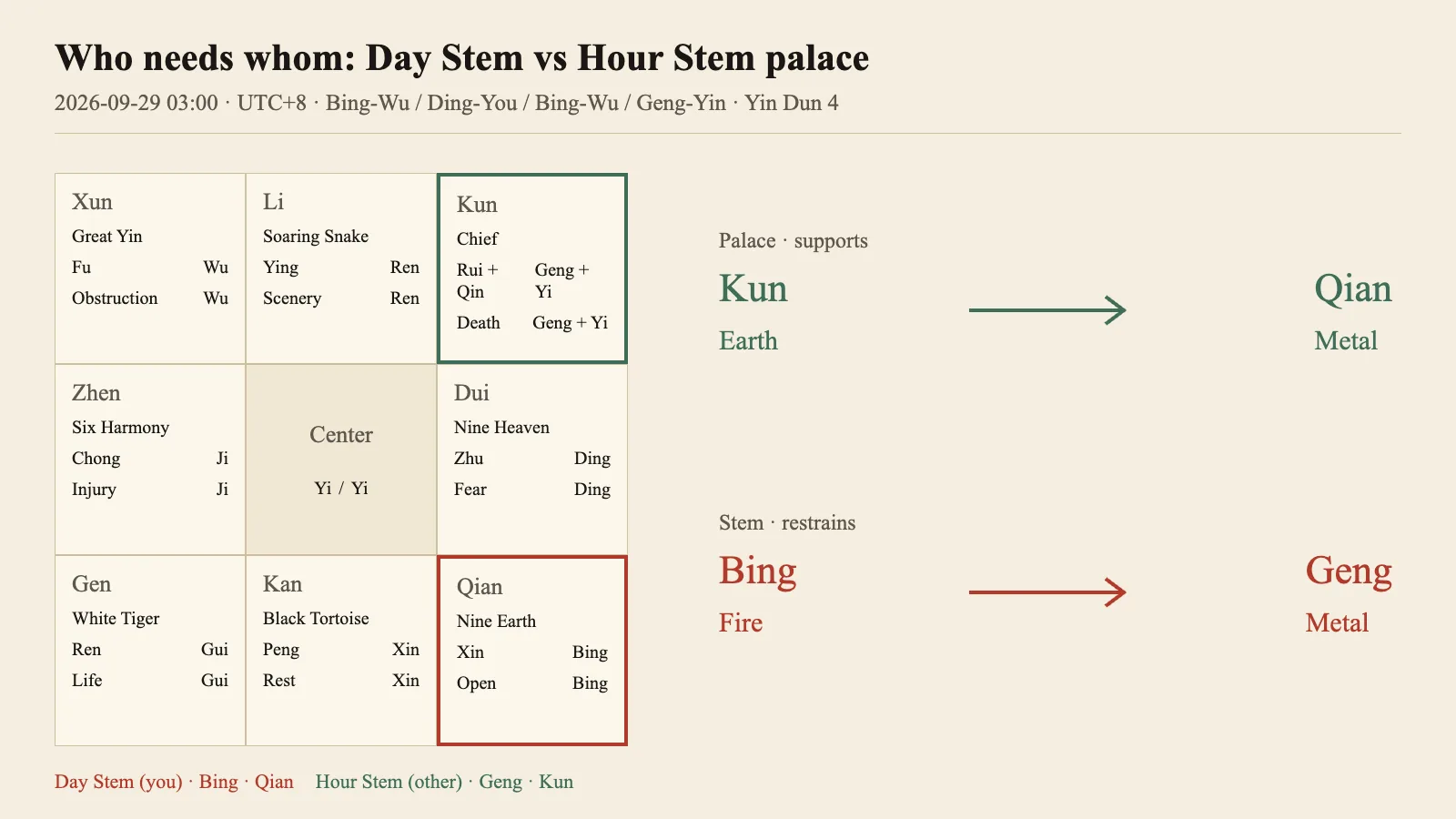
Chart cast on this site: 03:00 Beijing time (UTC+8), 29 September 2026, Autumn Equinox, Yin Dun Ju 4. Qian holds the Day Stem (you); Kun holds the Hour Stem (the other person).
First, unpack "needs more"
"Who needs whom" bundles several different things: who reaches out more, who supplies resources or emotional support, who wants the matter to move forward, and who would find it harder to walk away. These often diverge. Someone can be very proactive and still get no response; someone else can give a great deal without depending on the other person at all.
So before casting, write the question as one concrete matter with a time frame. "This month, am I or is the other person more eager to move this relationship forward?" works far better than "who loves whom more?" In business: "In this negotiation, does the other side need this order more than I do?" The sharper the question, the clearer each layer of the comparison becomes. The guide on how to ask a Qimen question shows how to phrase it.
Step 1: Place yourself and the other person
On this site, the palace holding the Day Stem stands for you, and the palace holding the Hour Stem stands for the other person or the party you are asking about. This is the default for every topic, and you still adjust it to the roles in your question. Anything beyond the two parties has its own Useful God: in a partnership, the project itself is read mainly through the Open Gate; in a relationship, the connection between you is read through the Six Harmony spirit.
Two checks come first:
- Find the right palaces. When a stem is Jia, Jia hides beneath one of the six Yi stems (Wu, Ji, Geng, Xin, Ren or Gui), the one that leads its ten-day cycle, so you locate that converted stem rather than searching the chart for the character Jia. The chart on this site highlights the converted Day Stem and Hour Stem (along with the decade leader) in blue.
- Roles are not the same as initiative. The Day Stem palace is you; it does not mean you are the one taking the lead. Who leads is something you find out by comparing, not something fixed at the start.
The Six Harmony matters in relationship questions, but it only shows whether a connection is in place. Being able to meet and talk does not mean both sides are taking it up.
Step 2: Compare four layers separately
The relationship between two palaces has four layers: the palace element, the heavenly stem, the gate and the star. The rule on this site is that each layer is compared on its own. A supportive palace relationship does not make the stems supportive, and a clash between gates says nothing about the stars.
Each layer shows one of five patterns. Call yourself A and the other person B:
| Chart relationship | What it can suggest | What it cannot prove |
|---|---|---|
| B supports A | The other person offers support, resources or care in this layer | They depend on you more |
| A supports B | You are the one giving in this layer | You are "lower" in the relationship |
| A restrains B | You apply pressure, demands or control | You dislike them |
| B restrains A | They put pressure on you or limit you | They do not care about you |
| Same element | Both sides are in the same state | Your needs match and things are harmonious |
The last row deserves attention. Under this site's rules, two palaces of the same element often point to a blockage, with neither side giving way. It should not be read as harmony by default.
Step 3: Judge strength within the same layer
Direction alone is not enough; you also need to know whether the side doing the supporting or restraining has any force behind it. Strength is layered too. Palaces have their own seasonal states (Prosperous, Supported, Resting, Confined and so on), and stars, gates and stems each have theirs. Do not use a palace's state to decide whether its stem is strong.
Once you know who is stronger within a layer, two interpretive leads are commonly used:
- The weaker side restraining the stronger side may show a wish to get closer or hold on, not rejection. Reading every restraint as dislike is a frequent mistake.
- The weaker side supporting the stronger side may show willingness without capacity: wanting to give but having little to give.
These are leads, not verdicts. To turn one into a specific conclusion you need at least two chart signals pointing the same way. With only one, note it and let real events confirm or refute it.
Then check the special states: Void, Tomb, gate clashes, Punishment, Fu Yin and Fan Yin. A Void palace gives weaker support, but Void alone does not mean nothing will come of it: check whether it is triggered and whether it is later filled and taken up. A Tomb holds strength in; Fu Yin tends toward standing still. These states can overturn an earlier reading, but none of them translates into "they don't love me" or "they will definitely come back."
A worked example from this site
The chart below was cast automatically on this site for 03:00 Beijing time on 29 September 2026. The four pillars are Bing-Wu, Ding-You, Bing-Wu and Geng-Yin, in the Autumn Equinox, Yin Dun Ju 4. The Chief Star (Tian Rui) and the Chief Gate (Death Gate) both sit in Kun. The person and question are a teaching assumption: imagine someone asking, "In this relationship, which of us needs the other more?"
The Day Stem Bing falls in Qian, so Qian is you. The Hour Stem Geng falls in Kun, so Kun is the other person. To follow along, enter 03:00 Beijing time on 29 September 2026 in the chart calculator to cast the same chart.
| Item | Qian (you) | Kun (the other person) |
|---|---|---|
| Palace element and state | Metal, Supported | Earth, Resting |
| Stem and state | Bing, Dead, in Tomb | Geng, Prosperous |
| Gate and state | Open Gate, Prosperous | Death Gate, Supported |
| Star and state | Tian Xin, Supported | Tian Rui (with Tian Qin lodged), Prosperous |
| Special state | Fu Yin | Fu Yin; hour Void (Wei) |
Comparing the four layers one at a time:
| Layer | Relationship | Strength in that layer |
|---|---|---|
| Palace | Kun Earth supports Qian Metal (they support you) | Kun Resting, Qian Supported: weaker supports stronger |
| Stem | Bing Fire restrains Geng Metal (you restrain them) | Bing Dead and in Tomb, Geng Prosperous: weaker restrains stronger |
| Gate | Death Gate (Earth) supports Open Gate (Metal) (they support you) | Death Gate Supported, Open Gate Prosperous: weaker supports stronger |
| Star | Tian Rui (Earth) supports Tian Xin (Metal) (they support you) | Tian Rui Prosperous, Tian Xin Supported: stronger supports weaker |
Looking at the palaces alone, you might conclude, "Their palace feeds mine, so they can't do without me." Layer by layer, the picture changes:
- They are giving, but whether it arrives is an open question. Palace, gate and star all run from them to you, so the direction of support is consistent, and in the star layer the stronger side supports the weaker one. But Kun sits in the hour Void, so whether this support actually lands depends on whether it is later filled and taken up.
- But what they give is limited. In both the palace and gate layers, the weaker side supports the stronger one. That is the "willing but short of capacity" lead, and appearing in two layers gives two signals that back each other up.
- You restrain them through the stems. Bing, Dead and in Tomb, restrains a Prosperous Geng: weaker restraining stronger, which can be read as you wanting to get closer or hold on. But this rests on the stem layer alone. Qian's Fu Yin and Tomb only show that you are stuck; they are not a second signal of wanting closeness. So this stays a note, not a conclusion.
- Both sides are standing still. Both palaces are in Fu Yin, which points to slow progress, with neither side likely to move first.
Put together, the careful reading is this: their support points your way, but with limited strength, and whether it arrives depends on what follows; you may be the one more eager to hold on, though the evidence is not yet enough; and for now neither side finds it easy to push things forward. What the chart cannot answer is what they think privately or whether they will speak first.
In this chart the Chief Star and Chief Gate both sit in Kun, the other person's side. The chart-reading guide treats the Chief Star as the dominant force and the Chief Gate as the channel of action, so the force driving this matter sits mostly with them. That is a direction for further checking, not something that settles who needs whom by itself.
Back to the San Yuan lines and the real situation
Comparing the two palaces is only part of a reading. San Yuan Qimen also follows the Yuan Shen, Yuan Qi and Tian Yi lines to see whether support is actually taken up and whether the matter moves forward. The same pattern also means different things when you have just met, during a cold spell, or when talking about getting back together. The full reading order is in how to read a Qimen chart.
Most important, write the reading so it can be checked:
- Positions: which palace is you, which is them, and why.
- Chart evidence: the relationship and strength in each layer, and how many signals support each point.
- Tendency: who is more proactive, who is giving, and where things are stuck.
- What to watch: over the next two weeks, who makes contact first, who proposes the next step, and who actually puts in time or resources.
- Review: when the period ends, compare with what happened and note which points held and which did not.
A chart cannot prove what the other person has not said. What finally answers "who needs whom" is their explicit response and their behavior over time. When reviewing, avoid keeping only the events that fit; Is Qimen accurate? explains how to review fairly.
FAQ
If one palace supports the other, does that show who needs whom?
No. Support shows the direction of giving in that layer—effort, care or resources—not dependence. You still need to check whether the four layers agree, who is stronger, and states such as Void and Tomb.
Is the Day Stem always me and the Hour Stem always the other person?
That is the default on this site, adjusted to the roles in your question. Anything beyond the two parties has its own Useful God: the project in a partnership is read mainly through the Open Gate, and the connection in a relationship through the Six Harmony.
If both palaces share the same element, do we want the same thing?
No. Under this site's rules, the same element often signals a blockage or neither side giving way. It is not harmony by default.
If I restrain the other person's palace, does that mean I don't like them?
Not necessarily. When the weaker side restrains the stronger, it can mean wanting to get closer or hold on. It is only a lead, though; you need at least two chart signals pointing the same way before stating it as a conclusion.
Can I cast again and again about the same relationship?
It is not recommended. If nothing has changed in reality, keep asking follow-up questions against the same chart. Cast again only when the stage of the relationship or a key condition has changed.