Timing in Qi Men Dun Jia: How to Read When Something Will Happen
In Qi Men Dun Jia, timing (ying qi) is the point where a matter turns. Learn the order of reading it: who drives the matter, whether the key gate is Void, whether the Travel Horse moves it, and which time scale fits. With a worked chart.
Timing (ying qi) is when a matter turns, not whether it ends well. Judge success first, then ask who drives the matter. If the key symbol is Void, watch the branch that fills or clashes it. If the Travel Horse touches it, an outside force is at work. Whether that branch means a day, month or year depends on how long the matter takes. A chart gives a window, not a date.
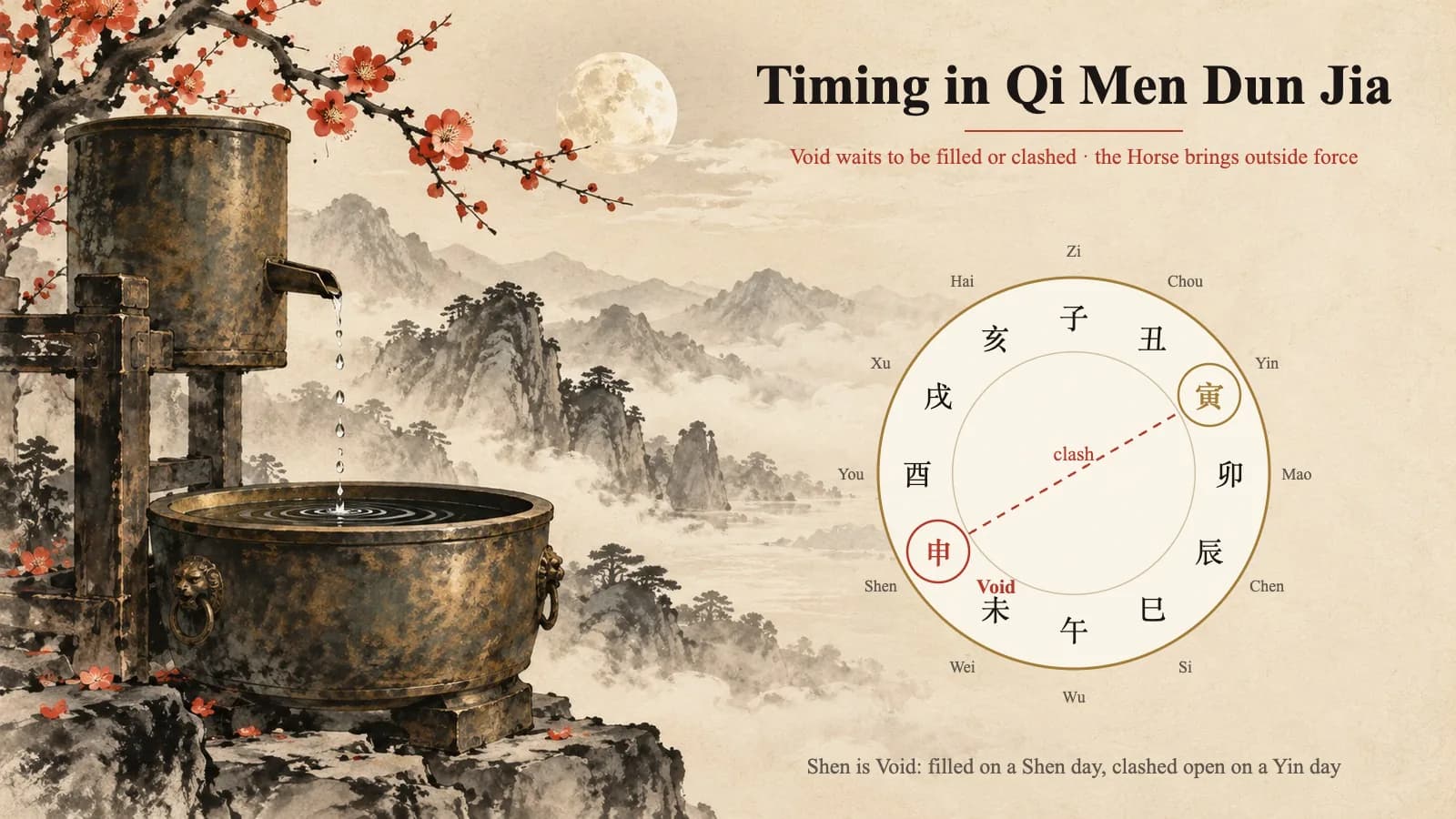
"When will I hear back?" is one of the most common questions people bring to a Qi Men Dun Jia chart. The technical name for the answer is ying qi (应期), the timing of a matter: the point at which news arrives, a stalled situation loosens, or something actually lands. To read it, first decide whether the matter can succeed at all, then work out who is driving it, then look for the moment the blockage opens or an outside push arrives, and finally convert that signal into an hour, day, month or year that fits the matter. What you get is a window, not a promise about a specific date.
Timing answers "when", not "how well"
Timing and outcome are separate questions. If a chart shows that something is hard to achieve, the timing you find is only when the situation turns, and the turn may not be good news. That is why this site reads success and obstacles first, and only looks for timing when the person has explicitly asked about time.
Put a time frame into the question as well. "When will this interview give me an answer?" and "Will I change jobs this year?" may point to the same symbols on the chart, but the time scales differ by a factor of ten or more, and that difference matters later. For help phrasing a question, see how to ask a Qi Men question.
Step 1: Who is driving the matter?
The San Yuan (Three Primes) school this site follows sorts a matter before looking for its timing, because each kind is read from a different part of the chart:
| Kind of matter | Examples |
|---|---|
| You can drive it yourself | Sending applications, arranging a meeting, filing a request |
| Someone else decides | Waiting for an interview result, a reply, an approval |
| An outside force pushes it | A sudden reorganisation at work, a change in the other person's family |
| Something is still missing | Conditions not ready, the right person not yet met |
Exactly which line of the chart each kind uses, and how the time is taken from it, belongs to the school's own method. The site's AI reading applies it, and we do not spell it out here. The two signals below are documented in classical sources and are the ones you will meet most often: Void and the Travel Horse.
Void: where things are stuck until filled or clashed
In every ten-day cycle, two Earthly Branches are left without a Heavenly Stem. They are called Void (空亡, kong wang). This site takes the Void of the cycle that contains the hour pillar, and the palaces holding those branches are Void palaces. When the symbol that stands for your matter (its key symbol, or yong shen) sits in a Void palace, the usual reading is that the matter is hanging, not yet grounded.
Void is itself a turning point, and it opens in one of two ways:
- Filled (填实): the Void branch itself arrives. If Shen (申) is Void, a Shen day or Shen month fills it.
- Clashed open (冲实): the branch opposite the Void arrives. Shen clashes with the Yin (寅) branch, so a Yin day or Yin month breaks it open.
Two cautions. First, Void only matters for timing when it falls on the key symbol or the main line of the matter; Void elsewhere on the chart is not a timing signal. Second, a Void key symbol does not mean "this will fail". It means "not yet", and you still need to check whether it gets filled and whether anything carries it through.
Travel Horse: when an outside force moves things
The Travel Horse (驿马, yi ma) marks where the strongest force of change sits at that moment. This site takes it from the hour branch, following the classical text Dunjia Jizhang (《遁甲集章》): in Shen, Zi or Chen hours the Horse is in Yin; in Yin, Wu or Xu hours it is in Shen; in Si, You or Chou hours it is in Hai; in Hai, Mao or Wei hours it is in Si.
Unlike your own action, the Horse usually points to something outside you that changes the situation. It only counts as a timing signal when it touches the key symbol or the main line directly, for example when it shares a palace with the key symbol or the palace it sits in activates the key symbol. A Horse that has nothing to do with your matter is not a timing signal.
Step 2: Hour, day, month or year?
Void and the Travel Horse both end up giving you an Earthly Branch, such as Yin. The same Yin can be a Yin hour, a Yin day, a Yin month or a Yin year. Which one applies depends on how long the matter naturally takes:
| The question | Natural cycle | The branch usually means |
|---|---|---|
| When will the interview result or a reply arrive? | A few days | A day |
| When will a project start, or a relationship turn? | Weeks to months | A month |
| When will I change careers or move home? | A year or more | A year |
The site instructs its AI reading to give only the time scale the chart supports, and a specific date without support in the chart should not be treated as a reliable answer. If the chart only supports a month, the answer should stop at the month. Turning that into an exact date looks more precise but has nothing behind it.
A worked example from this site
The chart below was cast automatically for 21:00 Beijing time (UTC+8) on 17 October 2026: pillars Bing Wu, Wu Xu, Jia Zi and Yi Hai, Cold Dew, Yin Dun Ju 6 (upper yuan). The question is a teaching assumption. Imagine someone casting on a Saturday evening and asking, "I sent out applications this week. When will I hear back?" That is a matter someone else decides, on a scale of days, so the branch is read as a day. The grid below is the site's own chart component, calculated live for that time; you can click any palace. You can also open the same chart in the calculator.
Useful God (Yong Shen) lookup
Career · Open Gate
For a job question, the key symbol is the Open Gate (开门). In this chart:
| Item | Chart |
|---|---|
| Open Gate's palace | Kun (Wei and Shen) |
| State of the gate and palace | Kun is at rest, the Open Gate is at rest; no Gate Pressures Palace, no tomb mark |
| Void | The hour Void is Shen and You; Shen in Kun is Void |
| Travel Horse | Hai hour, so the Horse is in Si, in Xun, not in the Open Gate's palace |
This example only shows how a Void is turned into dates; it is not a full reading of the job question. Reading it with the signals above:
- The Open Gate's palace carries a Void mark. The gate has no Gate Pressures Palace or tomb mark, and both the palace and the gate are at rest. Those are chart facts. Whether they mean the matter is hanging depends on the actual activations and follow-through on the chart, which we do not go into here. This example only shows how the Void branch becomes candidate dates.
- The Horse does not touch the Open Gate directly. The Horse sits in Xun, neither sharing a palace with the Open Gate nor activating it. That alone does not prove there is no outside push; the activations between palaces belong to the full reading.
- Two candidate days from the Void. Shen is Void, so a Yin day clashes it open and a Shen day fills it. The first Yin day after the cast is Bing Yin on Monday 19 October; the first Shen day is Ren Shen on Sunday 25 October. These are candidate windows to cross-check against the rest of the chart. The Void alone does not make them the timing of this job search.
What this cannot tell you is whether the news is good, or which company it comes from. The first needs a look at the overall state of the Open Gate's palace and the school's main lines; the second is beyond what a chart shows. If both windows pass with nothing, record the reading as not borne out and recheck the time scale, the key symbol and the other conditions, rather than casting again straight away. A missed window does not prove that something else must be blocking the matter. The full reading order is in how to read a Qimen chart.
Common mistakes
- Treating timing as outcome. Finding a date does not make the result good when it arrives.
- Reading Void as failure. Void means "not yet". Check whether it is filled, clashed open and carried through.
- Counting every Void and every Horse on the chart. Only those on the key symbol or the main line count.
- Naming an exact day or hour. The time scale must match the matter and what the chart supports.
- Recasting when the window passes. If nothing about the matter has changed, review the original chart. Casting again and again only produces contradictory answers.
The best way to check timing is to write the reading down when you cast: which two windows, and why. Then compare it with what actually happens. More on reviewing readings honestly is in is Qi Men Dun Jia accurate?.
Checking timing on this site
Enter the time of your question in the calculator; the chart marks the hour Void and the Travel Horse. For an interpretation, use Dunyuan AI reading and say "when" explicitly in your question. The AI judges success first, then looks for timing, and is instructed to give only the window the chart supports, with its reasons. Treat any specific date without such support as unreliable. For job questions, see also Qi Men Dun Jia for career questions.
FAQ
Can Qi Men Dun Jia timing pinpoint an exact day?
Sometimes it reaches the level of a day, but only when the matter itself runs on a scale of days and the signals are clear. More often you get one or two windows. Turning a month-level signal into a specific day is a common over-reading.
If the key symbol is Void, will the matter fail?
Not necessarily. Void means the matter is not grounded yet, and the day or month that fills or clashes it is often the turning point. Whether it succeeds depends on the overall state of the key symbol's palace and the school's main lines.
How is the Travel Horse found?
This site takes it from the hour branch: Shen, Zi and Chen hours put it in Yin; Yin, Wu and Xu hours in Shen; Si, You and Chou hours in Hai; Hai, Mao and Wei hours in Si. It only counts for timing when it directly activates the key symbol or the main line.
The window has passed and nothing happened. Should I cast again?
If neither the matter nor the circumstances have changed, no. Go back to the original chart and recheck it: was the time scale right, was the key symbol chosen correctly, was any condition missed? Also accept that this reading may simply not have been borne out. Cast again only when the real situation has clearly changed.
When is it not worth asking about timing?
When the chart shows the matter is unlikely to succeed, asking "will it work and where is it stuck" is more useful than "when". Timing answers when something happens, on the assumption that it can happen.