Qimen Destiny Chart vs Hour Chart: What's the Difference?
Compare a Qi Men Dun Jia destiny chart with an hour chart: birth-place clock, optional true solar time and the time of one question.
A question chart anchors one decision to a moment; manually entered time means UTC+8. A lifetime chart retains the clock time at birth. True solar time is optional only there, and starts off.
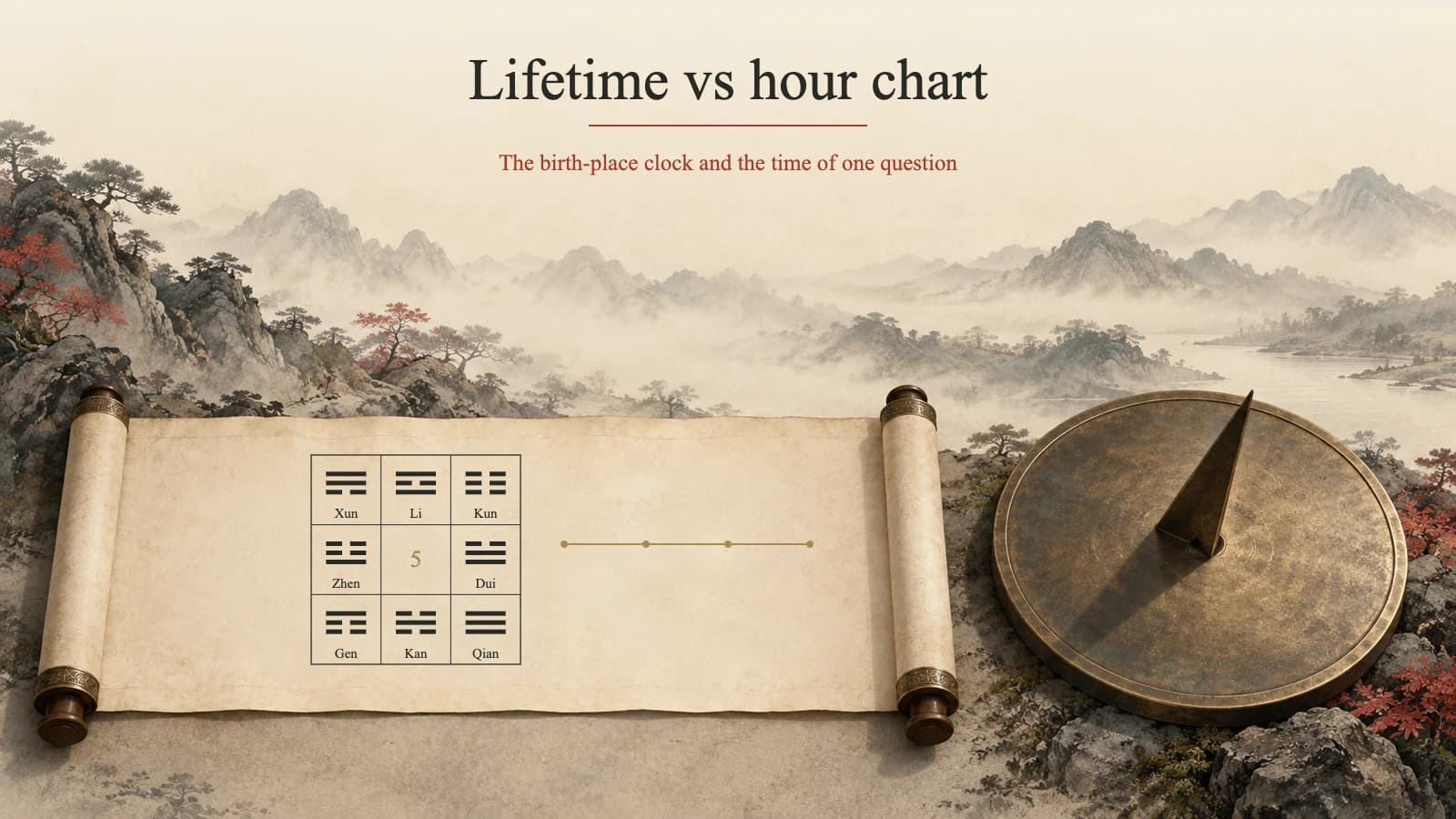
A Qi Men Dun Jia destiny chart, also called a lifetime chart, starts with birth information and supports a longer time horizon. A question-hour chart starts with the time of one question. Using the wrong time policy can change the calculated chart before interpretation even begins.
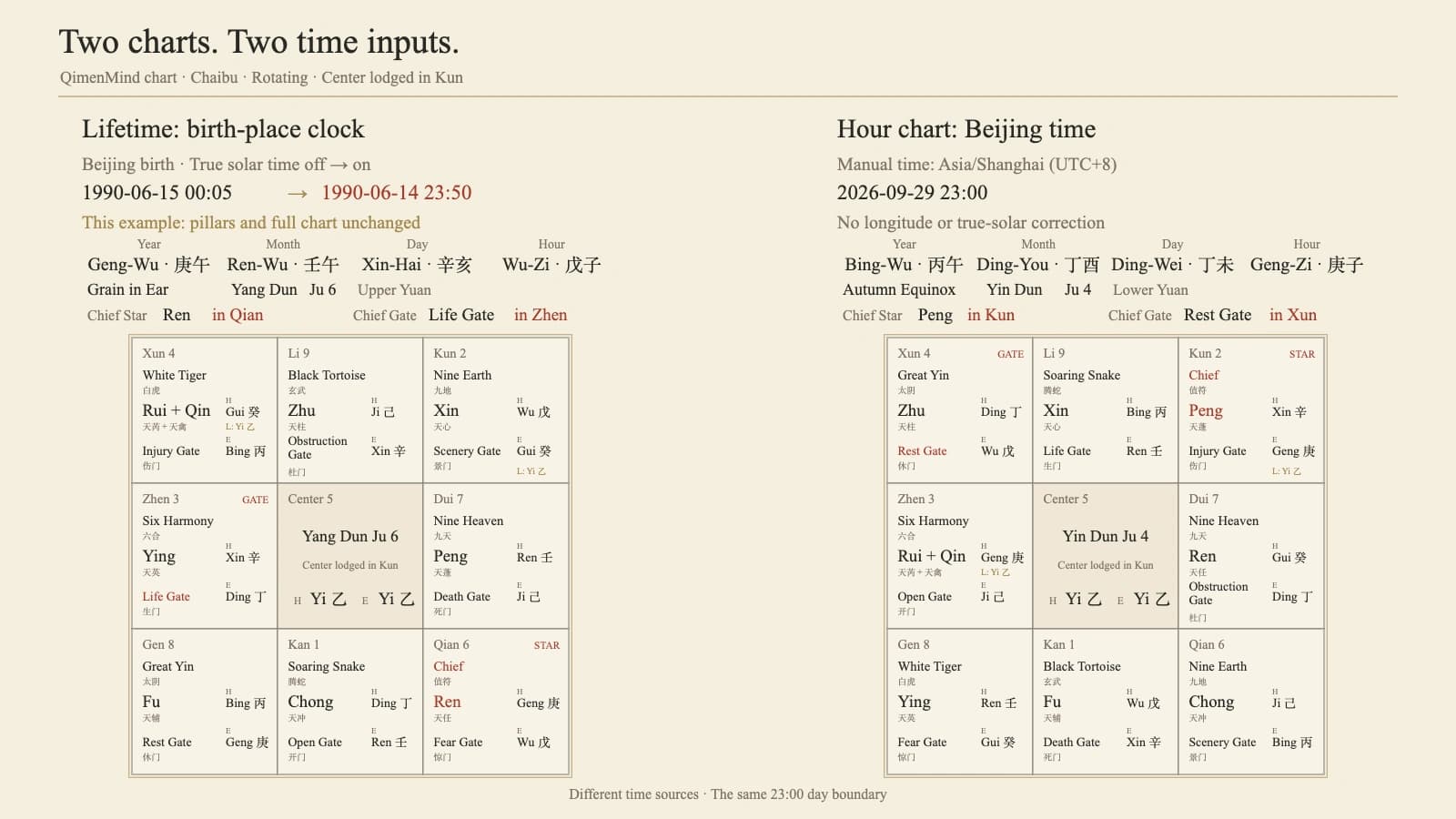
QimenMind comparison: the Beijing birth clock 1990-06-15 00:05 becomes 1990-06-14 23:50 with true solar time, with this chart unchanged. The question chart uses Beijing time 2026-09-29 23:00.
The question-hour clock
On the current-hour chart, “current time” is converted to Beijing time. A manually entered time is read as Asia/Shanghai (UTC+8), not your device zone, birthplace longitude or true solar time. The day pillar changes at 23:00. The solar term follows its crossing instant, and automatic Ju selection uses the Chaibu method. Record the exact moment and describe the decision you face.
The birth-place clock
The lifetime chart keeps the entered birth-place clock reading unchanged when the birth-place clock is used; it records the zone but does not convert that clock reading to Beijing time first. True solar time can be selected only for the lifetime chart, and is off by default. For example, a Beijing birth at 1990-06-15 00:05 becomes 1990-06-14 23:50 when that correction is enabled. The civil date changes, but under this site's 23:00 day boundary both inputs still yield the pillars Geng-Wu, Ren-Wu, Xin-Hai, Wu-Zi (庚午、壬午、辛亥、戊子). A date change does not automatically mean a pillar change in this example.
How to follow up
Use the lifetime chart to discuss longer periods alongside known events; use the hour chart to frame a specific choice with a deadline. Both readings depend on context and should be checked against real evidence. The San Yuan Qimen guide explains the site's framework, while the question guide helps narrow a single inquiry.
Put the two inputs side by side
| Point of comparison | Lifetime chart | Question hour chart |
|---|---|---|
| Starting information | Birth date and the clock reading at the place of birth | The current or manually selected moment for one question |
| Time convention | Keeps the birth-place clock reading; records its zone without first converting it to Beijing time | Converts “current time” to Beijing time; interprets manual entry as Asia/Shanghai, UTC+8 |
| True solar time | Optional only here and off by default; enabling it can change the effective birth minute or date | No longitude or true-solar adjustment |
| Time scale | Birth chart and longer periods, checked against known life events | One matter at a stated moment, with a concrete decision or deadline |
| Follow-up | Keep the birth information fixed while checking a period against events | Continue on the locked chart for the same matter; define a new question when the matter changes |
| Site entry | Lifetime chart | Current-hour chart or the homepage question chart |
“Birth-place clock reading” means the date and time shown locally where the birth occurred. A person born in Tokyo should not manually turn that reading into Beijing time before entering it in the lifetime tool. A manually entered question time follows the opposite policy: the numbers entered are read as a UTC+8 clock. If your phone in a different zone says 10:00, entering 10:00 manually does not ask the site to detect your phone's location. Check the corresponding Beijing clock time first. The similar nine-palace presentation on both pages does not make the input rules interchangeable.
The same day boundary, fed by different clocks
Both chart types eventually calculate pillars, term and Ju from their effective input time. QimenMind changes the day pillar at 23:00. For a question at Beijing time 2026-09-29 22:59, the pillars are 丙午 丁酉 丙午 己亥, the term is Autumn Equinox and the configuration is Yin Dun Ju 4. At 23:00 the pillars become 丙午 丁酉 丁未 庚子; the term and Ju stay the same, while Zhifu (Chief Star) Peng moves from Zhen to Kun and Zhishi (Chief Gate) Rest Gate moves from Kun to Xun. At 2026-09-30 00:00, those pillars and placements still match the 23:00 chart. Keeping the minute and the day-boundary rule is essential to reproducing either result.
A solar term can cross between two nearby minutes without changing the pillars. At Beijing time 2026-09-23 08:04, the pillars are 丙午 丁酉 庚子 庚辰, White Dew and Yin Dun Ju 3. At 08:06 the pillars remain the same, but the term becomes Autumn Equinox and the Ju becomes Yin Dun Ju 1. The automatic Chaibu selection uses the term, day-pillar Futou and Upper, Middle or Lower Yuan. This is why a date alone does not specify the configuration near a crossing. The lifetime chart also needs an accurate hour and minute, together with the state of its true-solar option.
A birth date can change while this sample chart stays the same
Take the fixed Beijing birth clock reading 1990-06-15 00:05 with true solar time off. QimenMind returns pillars 庚午 壬午 辛亥 戊子, Grain in Ear, Yang Dun Ju 6, Zhifu Ren in Qian and Zhishi Life Gate in Zhen. Enabling true solar time for that same birth input makes the effective time 1990-06-14 23:50, roughly fourteen minutes and forty seconds earlier. The civil date has crossed to the previous day. Under this site's 23:00 day boundary, however, this particular pair has the same pillars, term, Ju and Chief placements. A civil-date crossing is not proof that the chart changed in this example. Nor does this single unchanged chart imply that other births cannot change when the option is enabled. Preserve the original birth data and compare the displayed fields with one setting altered at a time.
Three ways to mix the tools up
First, converting a birth-place clock reading to Beijing time before entering it changes what the lifetime tool receives. Second, seeing an optional true-solar switch on the lifetime tool and expecting the question chart to use your longitude introduces a correction that the question tool does not perform. Third, treating a long-period description from the lifetime chart as an answer to whether to send a message, accept an interview or make a cooperation decision this week changes the question's scale. Write down whether you are examining a longer phase or one action with a review date before selecting the entry point.
For a lifetime chart, compare descriptions with events that have already happened and whose dates you can check. For a question hour chart, state the current stage, the person or object involved, available actions and a deadline. The San Yuan guide explains how Yuan Shen Gong, Yuan Qi Gong and Tian Yi Gong structure a reading; the question guide helps define one decision. Neither entry turns a single gate or palace into an unconditional result.
FAQ
Does the lifetime chart convert birth time to Beijing time?
With the birth-place clock setting, no. It preserves the birth-place clock reading and records the time zone.
Can I select true solar time on both charts?
No. True solar time is optional only on the lifetime chart and is off by default; the question chart does not apply it.
Do both chart types use the 23:00 day boundary?
Both ultimately use the site's four-pillar calculation with a 23:00 boundary, but they feed it different kinds of time input.