Why Qimen Calculators Give Different Charts for the Same Time
Qimen calculator results differ? Compare time zones, the 23:00 day boundary, solar terms, Chaibu bureaus and rotating palaces.
A matching timestamp does not guarantee matching chart rules. Lock the time to UTC+8, check the 23:00 day boundary, then compare the solar term, Chaibu bureau and rotating palace layout.
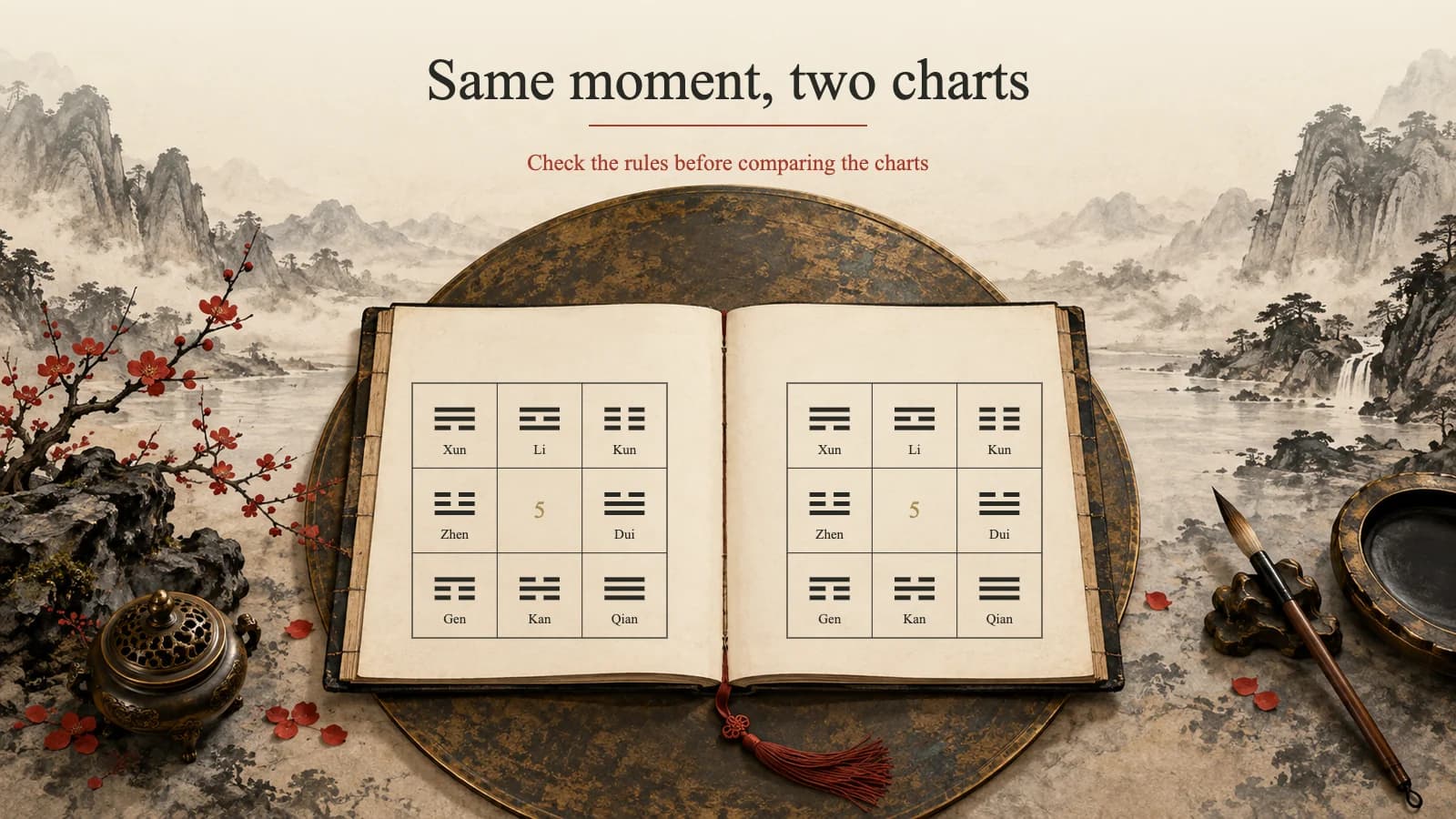
If one Qimen calculator gives a different nine-palace chart from another for the same time, begin with their inputs and rules. Comparing only the finished grid hides the step where they diverged. You can use the Qimen chart tool as a fixed reference.
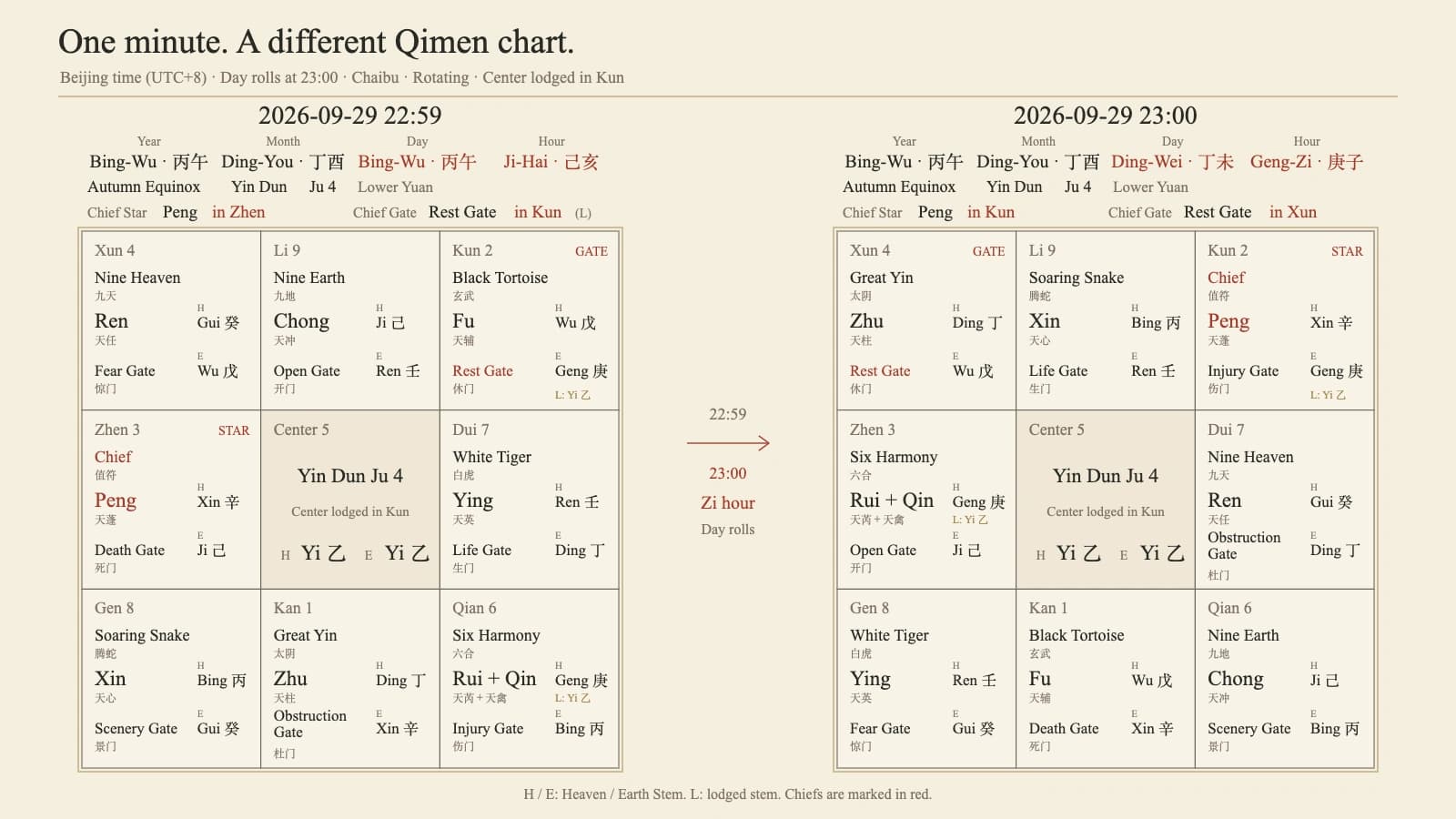
QimenMind charts for Beijing time 2026-09-29 22:59 and 23:00. Autumn Equinox and Yin Dun Ju 4 remain unchanged; the Day and Hour pillars and Chief placements change.
Compare upstream fields first
- Clock time and zone. QimenMind interprets a manually entered hour as Asia/Shanghai (UTC+8), regardless of your device location. “Current time” is converted to Beijing time. The question chart does not apply longitude or true solar time.
- Day boundary. QimenMind calculates the four pillars from the entered time. The day pillar changes at 23:00, the start of the Zi hour. A one-minute difference across that boundary matters.
- Solar term and bureau. The solar term follows its crossing instant. The automatic Ju uses the solar term and the day-pillar Futou to identify Upper, Middle or Lower Yuan under the Chaibu method. A manual bureau selection overrides that result.
- Palace arrangement. This is a rotating hour chart: the earth plate distributes the stems forward or backward by bureau, the heaven plate rotates with the Zhifu (Chief Star), and the center-five is lodged in Kun. “Fei Fu” progression is an interpretation layer, not a flying-plate layout.
- Reading. Once the chart fields agree, compare the question, chosen focal point and interpretation.
A reproducible comparison
For Beijing time 2026-09-29 23:00 with automatic bureau, this calculator returns pillars Bing-Wu, Ding-You, Ding-Wei, Geng-Zi (丙午、丁酉、丁未、庚子), the Autumn Equinox term, Yin bureau 4, Zhifu (Chief Star) Peng in Kun and Zhishi (Chief Gate) Rest Gate in Xun. If another chart still has Bing-Wu as its day pillar, check its 23:00 boundary. If the pillars match but the bureau does not, compare the solar-term and Chaibu settings. If those match, inspect rotating versus flying layouts and center lodging. These are the results of this QimenMind chart, not a claim that every tradition uses the same rules.
A lifetime chart uses another input policy: it retains the birth-place clock reading. True solar time is optional only for the lifetime chart and is off by default. See the chart-reading guide for field names and the systems comparison for terminology.
A comparison table that locates the first mismatch
The useful question is not “Which grid looks right?” but “At which input or calculation field do the two results first separate?” The table describes QimenMind's declared behavior. It does not assume that another calculator implements a method correctly merely because its settings menu uses a familiar label.
| Field to compare | QimenMind behavior | What to ask of the other calculator |
|---|---|---|
| Time zone and true solar time | Manual question time is Asia/Shanghai, UTC+8, with no longitude correction | Is the same instant being compared, or merely the same clock reading? Was a local or solar correction applied? |
| Day boundary | The day pillar rolls at 23:00 | Does the other tool roll at the start of the Zi hour or at midnight? |
| Solar term | The term follows its crossing instant | Which side of the crossing does the entered minute fall on? |
| Ju selection | Automatic Chaibu uses the term, day-pillar Futou and Upper, Middle or Lower Yuan; a manual Ju overrides it | Is the mode Chaibu, Zhirun or another rule? Was a manual selection left on? |
| Plate layout | Rotating hour chart, with the center lodged in Kun | Does the other tool rotate or fly its symbols, and where does it lodge the center? |
| Interpretation | Useful God and palace relationships are chosen for the question | Are the two readings about the same person, event and available action? |
Some traditional discussions use the expressions jie qi (“receiving the term”) and chao shen (“the head preceding the term”) when the cycle of a day-pillar Futou and the solar-term crossing do not line up neatly. In plain language, the term boundary and the five-day head need to be checked together. QimenMind's automatic Ju follows Chaibu. If another tool mentions Zhirun or one of those traditional expressions, request its displayed term, Futou, Yuan and Ju for the precise minute. A method name alone does not reveal every step of its implementation.
A one-minute change at the day boundary
At Beijing time 2026-09-29 22:59, QimenMind returns the four pillars 丙午 丁酉 丙午 己亥, Autumn Equinox and Yin Dun Ju 4. Zhifu (Chief Star) is Peng in Zhen; Zhishi (Chief Gate) is the Rest Gate in Kun. At 23:00 the pillars are 丙午 丁酉 丁未 庚子. The term and Ju remain the same, while Zhifu is now Peng in Kun and Zhishi is the Rest Gate in Xun. At 2026-09-30 00:00, these pillars and Chief placements still match the 23:00 result. The calculator has not performed a second day change at midnight.
This pair is particularly useful because the Ju number did not change. Matching Yin Dun Ju 4 on two screens therefore does not establish that their pillars, Zhifu and Zhishi match. If the other screen still shows the earlier day pillar at 23:00, inspect its day boundary first. If its pillars agree, move down to the term and Ju. Changing several settings at once makes the source of the difference impossible to identify.
A solar-term crossing without a pillar change
A second fixed pair separates term selection from the four pillars. At Beijing time 2026-09-23 08:04, the pillars are 丙午 丁酉 庚子 庚辰; the term is White Dew, the configuration is Yin Dun Ju 3, Zhifu is Rui in Kan and Zhishi is the Death Gate in Kun. At 08:06, the pillars remain identical while the term is Autumn Equinox and the configuration is Yin Dun Ju 1. Zhifu is Ying in Gen and Zhishi is the Scenery Gate in Zhen. The term crosses near 08:05.
If two calculators agree on the pillars during that two-minute window yet disagree on the Ju, inspect their term crossing and Ju method before blaming the plate layout. “September 23” is not precise enough to reproduce this case. The minute, the time convention and the tool's manual-override state belong in the record.
Where to look on the QimenMind chart
After entering a fixed time in the chart tool, copy the displayed date and minute, pillars and solar term. Record Yin or Yang Dun, Ju, Yuan and Xunshou next. Then copy the Zhifu star, the Zhishi gate and each palace. The chart header identifies the Chief fields; the nine-palace grid shows where they land. If a center position is involved, use the site's Kun lodging rule when interpreting what is displayed. Only after those foundation fields agree should you compare earth and heaven plate stems, gates, stars, spirits and special palace states. Fei Fu progression belongs to the subsequent San Yuan reading; it is not evidence of a flying-plate casting method.
Keep the original timestamp and change one setting at a time. Put both tools' values in adjacent columns and mark the first unequal row. If the other product supplies only a screenshot of the nine cells and no pillars, term, Ju or center rule, the available evidence establishes a difference but does not yet identify its cause. Once the calculated chart fields agree, a different written answer may come from the Useful God selected for the question or from different real-world facts. The reading guide explains how to examine that later layer.
FAQ
What should I check before comparing palaces?
Check that both timestamps mean UTC+8, then check the 23:00 day boundary, solar term and Chaibu bureau.
Does a different chart prove that one app is broken?
No. A different time zone, day boundary or charting method can produce different results under stated rules.
Is Fei Fu progression a flying-plate chart?
No. Here it is applied after a rotating chart has been calculated; it is not the plate layout.