Is Qi Men Dun Jia Accurate? What You Can and Can't Verify
Is Qi Men Dun Jia accurate? Learn which chart fields you can verify and how to review a reading against real events, without a universal accuracy score.
Separate chart reproducibility from the value of a reading. You can audit timestamps, pillars and palace placement; interpreting a decision requires context and checking later events against the original claim.
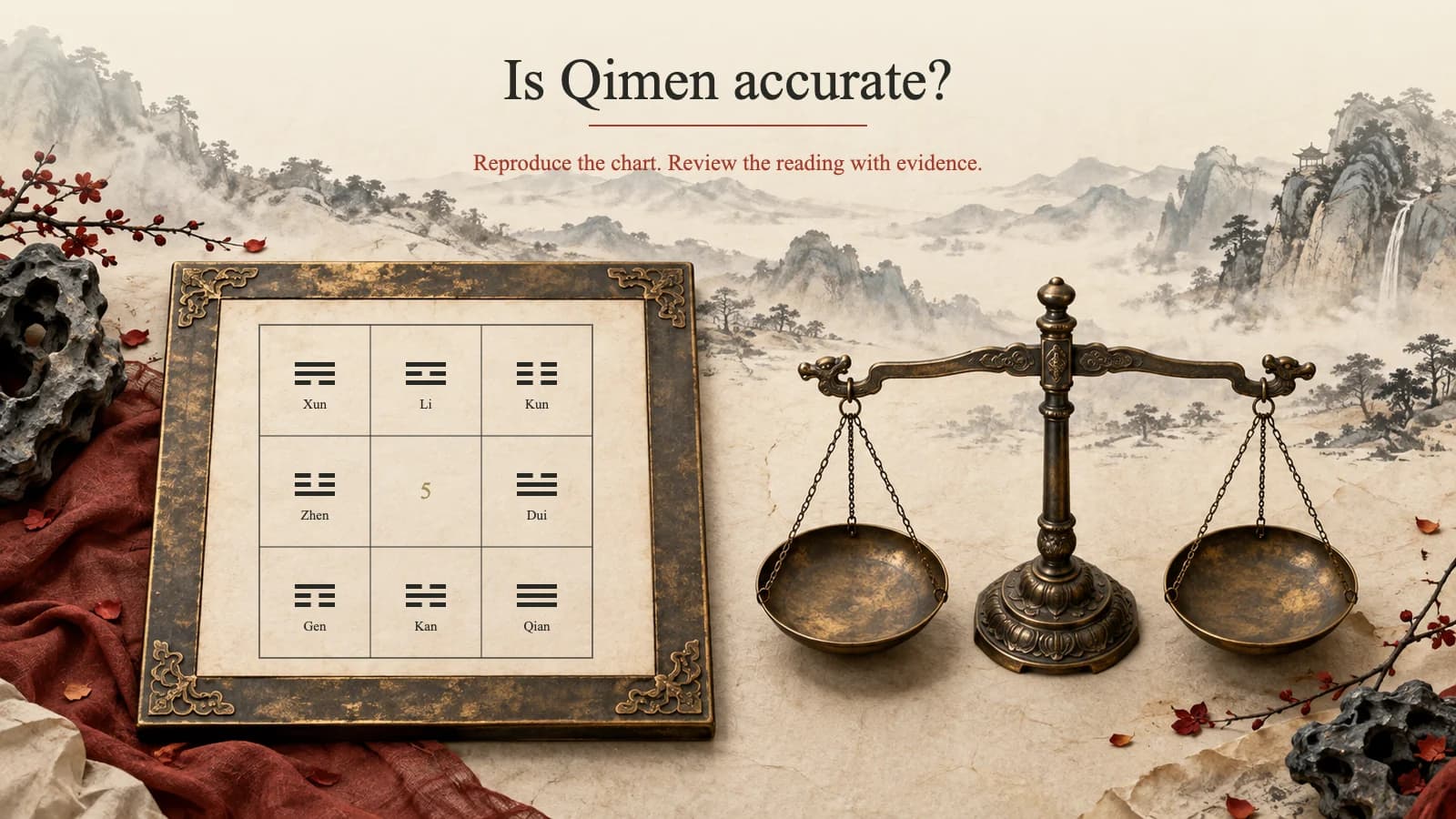
Asking “Is Qi Men Dun Jia accurate?” can mean two different things. Did the site calculate the chart according to its stated rules? Did a reading help someone reason about a real decision? The first is reproducible. The second needs a specific question and an honest record of what happened afterward. Neither means that a chart proves the future.
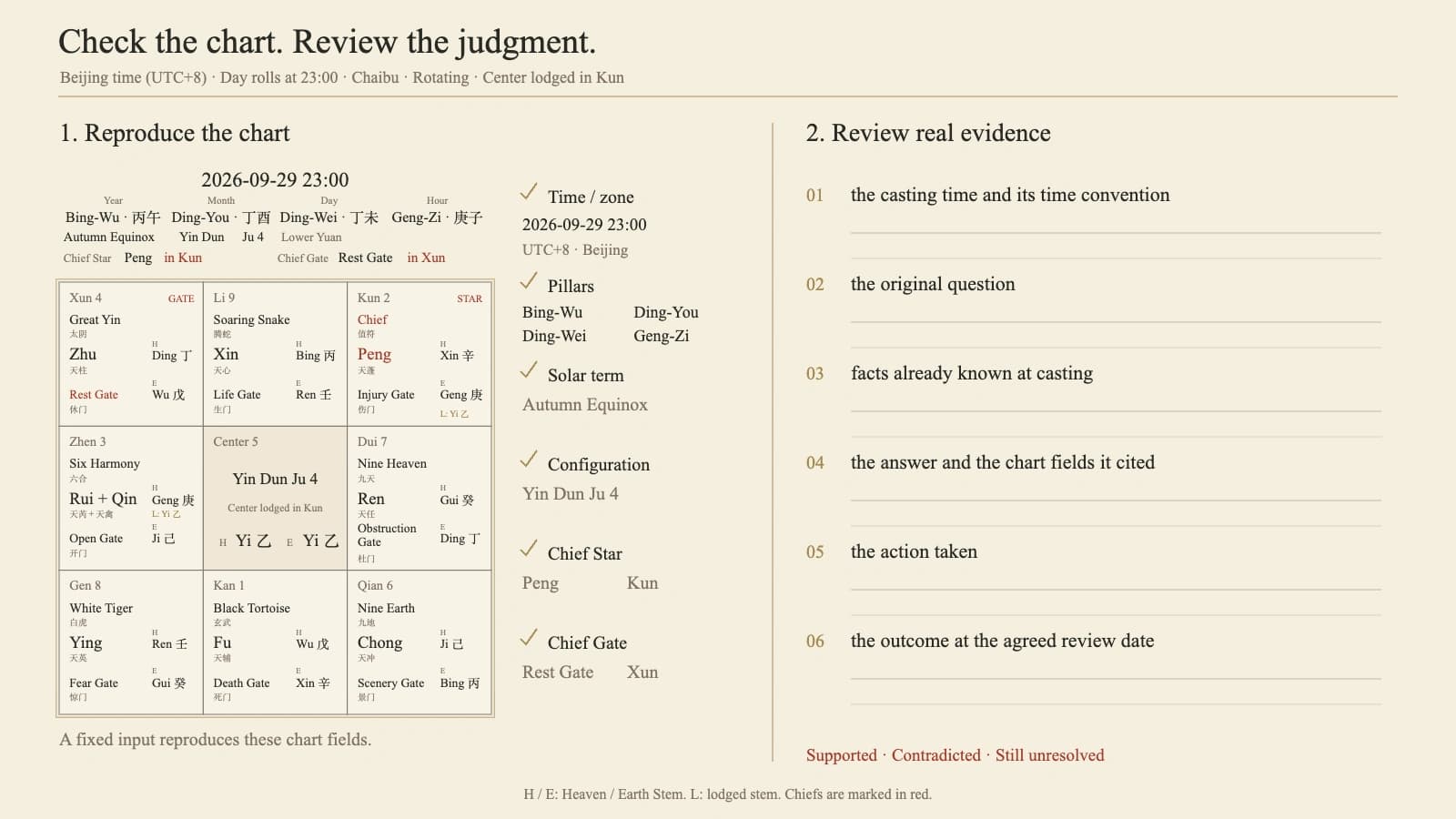
QimenMind chart for Beijing time 2026-09-29 23:00. Chart fields can be reproduced; the six-column review log requires real evidence to evaluate the reading.
What can be audited
Record the input in the chart tool, then inspect the four pillars, solar term, bureau, Zhifu (Chief Star) and Zhishi (Chief Gate). This site's question chart treats manual time as Beijing time and derives its automatic bureau by Chaibu. If you are comparing apps, the chart-difference checklist helps isolate a mismatch before you compare prose.
What depends on the question
Two people asking at the same hour may receive the same underlying chart. Their subjects, options and chosen focal points can differ, so the reading can differ too. State the decision, the people involved, the deadline and the evidence you already have. The question-writing guide gives a practical structure. Keep the initial reading and compare it with what later occurred rather than remembering only the parts that seemed right.
Medical symptoms, legal rights and investments require qualified professional advice and primary evidence. A Qimen reading does not replace a clinician, lawyer or financial analysis. The chart is available without an account. Dunyuan AI reading requires sign-in; the first three AI questions are free in total per account. You should still check its claims against the chart and the world.
Two claims require two kinds of evidence
A reproducible chart and a useful interpretation should be evaluated separately. The first claim is computational: given a date and minute, a time convention, a day boundary and a stated Ju method, can another run reproduce the same pillars, term, configuration and Zhifu and Zhishi placements? QimenMind exposes those fields on its chart. For a manually entered question time it uses Beijing time, and its automatic Ju follows Chaibu. The field comparison guide shows how to find the first disagreement. Passing this check says that a particular chart follows the declared method. It does not demonstrate that an event will happen.
The second claim concerns a reading of one event. The reader must identify the people or objects in the question, select the Useful God (Yong Shen), compare relevant palaces and describe which real-world conditions affect the judgment. Two people can cast at the same hour and share the same base chart while asking about different events. A statement such as “this gate is favorable” has little testable content until it says whose action, against which target, and by what deadline. Keep those interpretation choices visible so the later outcome can be compared with the original statement rather than with a convenient memory of it.
Ask a question whose result you can observe
Compare “Will my career go well?” with “I have completed two interviews; a competing offer expires this week. Should I keep waiting for the first employer before the deadline?” The second question identifies one event, its stage, the decision and a time window. A later record can say whether a reply arrived, when it arrived and which choice the person made. This is an example of question design, not a prediction about an employer. The question guide offers further examples of keeping one chart tied to one matter.
For a relationship question, an observable event might be whether a planned conversation occurs and what each person explicitly says. A chart cannot directly establish another person's unspoken thoughts. Words, agreements and sustained conduct provide evidence about the real relationship. If a question has no deadline or observable outcome, record it as an open reflection rather than scoring a reading as right or wrong afterward.
A practical review log has six columns: the original question, the casting time and its time convention, facts already known at casting, the answer and the chart fields it cited, the action taken, and the outcome at the agreed review date. Mark each claim as supported, contradicted or still unresolved. Do not rewrite “may be delayed” into “will arrive on Friday” after learning the result. Such a log cannot produce a universal accuracy percentage from one person or a few events, but it can make a single conclusion accountable.
Why the same hour can lead to different readings
The base pillars, term and palaces may be shared. The Useful God and host-guest relationship depend on the question. One person may ask about entering a company, another about a partner's payment, and a third about whether to send a message. Calling the same star “good” for all three skips the role it plays in each event. A reading should name the selected role and palace before describing the relationship, the strength or weakness of that palace, and conditions such as emptiness or a pressed gate. The public Zhifu and Zhishi guide likewise treats the Chief Star and Chief Gate as coordinates for analysis rather than automatic verdicts.
A follow-up about the same matter can continue from the locked chart. If the subject changes to another person or another event, define a new question and, when appropriate, cast a new chart. Recasting the same question repeatedly until one answer sounds reassuring weakens the record: it becomes unclear which timestamp and answer are being evaluated. When two readings conflict, first compare their inputs, Useful Gods and known facts, then ask which claim actually differs.
Where a reading should stop
Medical symptoms and treatment require clinical records and qualified care. Legal rights require the relevant documents and professional advice. Investment decisions require product details, downside risk and financial judgment. Urgent safety situations call for direct real-world help. A Qimen reading can help organize a question, but those decisions need evidence that the chart does not contain. The same boundary applies to AI prose: a fluent answer can misread a field or invent a background detail the user never supplied.
For Dunyuan AI reading, first cast the chart and check the time, Ju, Zhifu and Zhishi the answer cites. Ask which statements are chart observations and which are conditional interpretations. Charting does not require sign-in. AI reading does; the first three AI questions are free in total per account. That allowance describes access, not the reliability of a particular conclusion.
FAQ
Can a chart prove that an event will happen?
No. You can audit how the chart was calculated, but the chart alone does not establish a future outcome.
Why can two people in the same hour get different readings?
Their base chart may match while the question, subject and focal point of interpretation differ.
Can this replace medical or legal advice?
No. Seek qualified advice based on the relevant records and circumstances.