Can AI Cast a Qi Men Dun Jia Chart? A DeepSeek Test and Prompt Guide
Qi Men Dun Jia AI: compare one DeepSeek test with verified chart fields, then copy a prompt template for interpreting a fixed chart.
In one test for Beijing time 2026-09-29 23:00, DeepSeek named the solar term correctly but gave a different day pillar, bureau and Zhifu and Zhishi placements from this calculator. Fix the chart before asking for a reading.
For Qi Men Dun Jia AI, interpreting a supplied chart and calculating one from a timestamp are separate tasks. Asking it to derive the pillars, bureau and palaces from a timestamp adds several places where an error can hide. We ran one reproducible, tool-free DeepSeek test. It is a case study, not an accuracy survey of DeepSeek or other models. ChatGPT was not tested here.
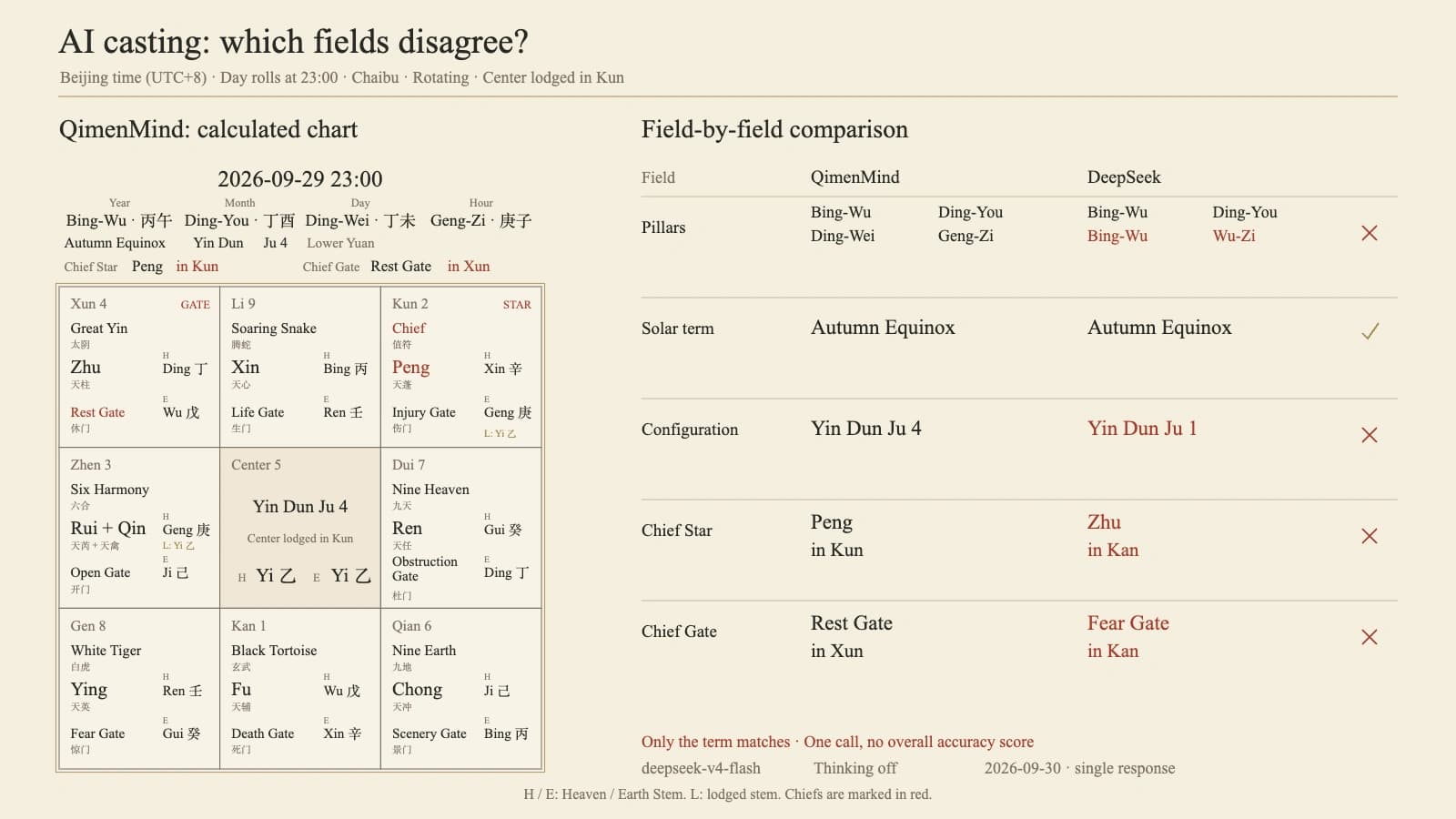
QimenMind chart compared with one DeepSeek response for Beijing time 2026-09-29 23:00: deepseek-v4-flash, thinking off, called on 2026-09-30. Only the solar term matches.
The fixed prompt and result
The prompt specified Beijing time 2026-09-29 23:00, Chaibu, a rotating plate, center-five lodged in Kun, the 23:00 day boundary and no true-solar correction. It asked for pillars, solar term, Yin/Yang bureau, Zhifu (Chief Star) and Zhishi (Chief Gate) without a charting tool. On 2026-09-30, we asked DeepSeek model deepseek-v4-flash with thinking disabled.
| Field | QimenMind calculator | One DeepSeek response |
|---|---|---|
| Pillars | 丙午 丁酉 丁未 庚子 | 丙午 丁酉 丙午 戊子 |
| Solar term | Autumn Equinox (秋分) | Autumn Equinox (秋分) |
| Bureau | Yin 4 | Yin 1 |
| Zhifu (Chief Star) | Peng in Kun | Zhu in Kan |
| Zhishi (Chief Gate) | Rest Gate (休) in Xun | Fear Gate (惊) in Kan |
The response said it applied the Zi-hour day boundary while still supplying a day pillar that disagreed with this site's calculation. It also warned that its palace placements might be wrong without a tool. This comparison establishes a difference for this single model output against this site's declared method. Traditions can also use different methods; the table does not adjudicate them all. The exact prompts and complete visible response appear below.
A safer sequence for AI assistance
First create a chart with the calculator. Confirm its time basis, pillars, solar term, Chaibu bureau and Zhifu and Zhishi placements using the difference checklist. Then give the established fields and your concrete question to AI. Keep Fei Fu progression separate from the flying-plate method. The AI reading guide describes the site's product: charting requires no sign-in, AI reading does, and the first three AI questions are free in total per account. Other general models merit the same checking process, but they were not tested here.
The two prompts and what the model actually returned
The first call used the model's default thinking mode. Its complete prompt was in Chinese; the wording matters because it explicitly prohibited tools and specified the calculation convention:
请不要调用排盘工具,直接按你的知识心算一个时家奇门盘。固定输入:北京时间(Asia/Shanghai)2026-09-29 23:00;手动输入,不做真太阳时修正;采用拆补法、转盘、中五寄坤、子初换日。请依次给出四柱、节气、阴阳遁与局数、值符星及落宫、值使门及落宫。不能确定的字段请明确写不确定,不要编造。
That call returned an empty visible response. It provided no fields to score. The second call disabled thinking mode. Its full prompt was:
请不要调用工具,心算时家奇门盘。固定输入:北京时间 2026-09-29 23:00,拆补法、转盘、中五寄坤、子初换日,不校正真太阳时。只输出四柱、节气、阴阳遁局数、值符星与落宫、值使门与落宫。不确定请写不确定。
Here is the complete visible output of that second call, in the original Chinese:
按你给定条件(北京时间 2026-09-29 23:00;拆补法、转盘、中五寄坤、子初换日、不校正真太阳时)心算:
- 四柱:丙午 丁酉 丙午 戊子
说明:23:00 已按“子初换日”算作次日早子时,所以日柱取 2026-09-30 的丙午日,时柱为戊子。 - 节气:秋分后、寒露前,仍属秋分。
- 阴阳遁局数:阴遁一局
- 值符星与落宫:天柱星落坎一宫
- 值使门与落宫:惊门落坎一宫
其中“值符星与落宫、值使门与落宫”我按心算给出,但这类时家奇门细节在无工具校验下存在出错可能。
One empty response and one nonempty response cannot establish a repeatable error rate. The table compares that nonempty output with QimenMind's declared calculation at one instant. A different Qimen tradition may itself use different casting rules; a tool-free model response should therefore be checked against an explicitly chosen method, not an unspecified universal chart. Someone repeating the exercise should preserve the exact timestamp, prompt, tool permission, model output and calculator fields. A screenshot of the final prose alone omits the information needed to diagnose where the divergence began.
Audit the errors in calculation order
Day boundary. The response said that 23:00 was after the Zi-hour boundary, yet supplied a Bing-Wu day and Wu-Zi hour. QimenMind returns Ding-Wei day and Geng-Zi hour at that moment. Its 22:59 sample has the Bing-Wu day. This observation shows that the explanation and returned pillars do not align with the site's fixed chart. It does not reveal which hidden rule the model actually followed. Check the day and hour pillars before reading a palace interpretation.
Solar-term crossing. The response named Autumn Equinox, which matches this sample. That match says little about a boundary minute. At Beijing time 2026-09-23 08:04, QimenMind shows White Dew and Yin Dun Ju 3; at 08:06 it shows Autumn Equinox and Yin Dun Ju 1 while all four pillars remain the same. Ask for both sides of a documented crossing if you are testing term handling. A model that gets one term name right should not automatically be credited with calculating the term instant or the resulting Ju correctly.
Ju and manual overrides. QimenMind uses the term, day-pillar Futou and Upper, Middle or Lower Yuan in its automatic Chaibu choice. The nonempty response gave Yin Dun Ju 1; the fixed chart gives Yin Dun Ju 4. If the calculator's manual Ju override is on, first record or clear it before comparing an automatic result. “Yin Dun” alone is not the complete configuration. A different Ju changes the arrangement used downstream, so it deserves its own line in the comparison table.
Palaces and layout. Compare the name and palace of Zhifu (Chief Star) separately from those of Zhishi (Chief Gate). The response gave Tian Zhu in Kan and the Fear Gate in Kan; the fixed chart gives Peng in Kun and the Rest Gate in Xun. QimenMind casts a rotating hour chart and lodges the center in Kun. A flying-plate tool or a different center convention needs a different comparison. Fei Fu progression in the site's interpretation is not a flying-plate casting rule, even though both names contain the word “flying.”
Useful God and real-world facts. Even if a model is given correct pillars, Ju and placements, it can still guess the wrong subject, chosen Useful God or stage of the event. A useful question identifies the people involved, current progress, available actions and review date. Ask the reading to name the Useful God (Yong Shen), the relevant palaces and which statements came from the user's facts. If it adds facts the user never supplied or turns one favorable symbol into a certain result, return to the original question and outside evidence.
How to Write a Qi Men Dun Jia AI Prompt
Start at the chart tool and copy the exact casting date, minute and time zone, four pillars and solar term, Yin or Yang Dun, Ju and Yuan, whether the Ju was automatic or manually selected, Xunshou, Zhifu (Chief Star), Zhishi (Chief Gate) and their palaces. Then add one specific matter: what has happened, what stage it has reached, what decisions are available and when the result could be observed. Ask AI to repeat the chart fields it is using before it interprets them. If a repeated field differs from the fixed chart, correct that field first. The AI reading guide describes the site's locked-chart workflow. Charting needs no account; AI reading requires sign-in, and the first three AI questions are free in total per account. This procedure is useful with other general models too, although this article reports no test of them.
Copy this template and replace the placeholders with your verified fields and question:
Use the verified Qimen chart below to discuss this question. Do not recalculate or change the chart. If a field is missing or inconsistent, first identify what needs confirmation instead of guessing.

Casting date, time and time zone: [fill in]
Four pillars: [fill in]
Solar term: [fill in]
Yin or Yang Dun, Ju, Yuan, automatic or manual Ju: [fill in]
Xunshou: [fill in]
Zhifu (Chief Star) and palace: [fill in]
Zhishi (Chief Gate) and palace: [fill in]
Original question: [fill in]
Known facts: [fill in]
Available actions: [fill in]

First repeat the chart fields you are using. Then give a conditional judgment and next step, distinguishing the facts I supplied from your interpretation.
FAQ
Does this prove DeepSeek always calculates Qimen incorrectly?
No. It is one fixed input and one nonempty response, with no repeat-sample estimate.
Which fields should I check first?
Check the time, pillars and solar term before the Chaibu bureau and rotating palace placements.
Can I still ask AI to interpret the result?
Yes. Supply a verified chart and a specific question, then check the interpretation against the fields and outside evidence.