How to Read a Qi Men Dun Jia Destiny Chart: Birth Chart, Life Cycles and Annual Influences
Read a Qi Men Dun Jia destiny chart in order: the birth chart and Life Palace, the current ten-year life cycle, then each annual palace. With a worked example.
A destiny chart has three layers: the birth chart for long-term character, eight major life cycles for ten-year stages, and annual palaces for what a given year triggers. Find the Life Palace first, place the current cycle by its starting age, then read the ten years inside it. No layer replaces another, and no single layer is enough to predict a specific event.
Once you have cast a Qi Men Dun Jia destiny chart, the first look can be overwhelming: nine palaces, eight major life cycles, ten annual palaces. Where do you start? The destiny chart on this site is organized in three layers. The birth chart shows your long-term baseline, the major life cycles show ten-year stages, and the annual palaces show what a particular year sets in motion. This article reads one complete chart in that order and explains what a destiny chart can and cannot tell you.
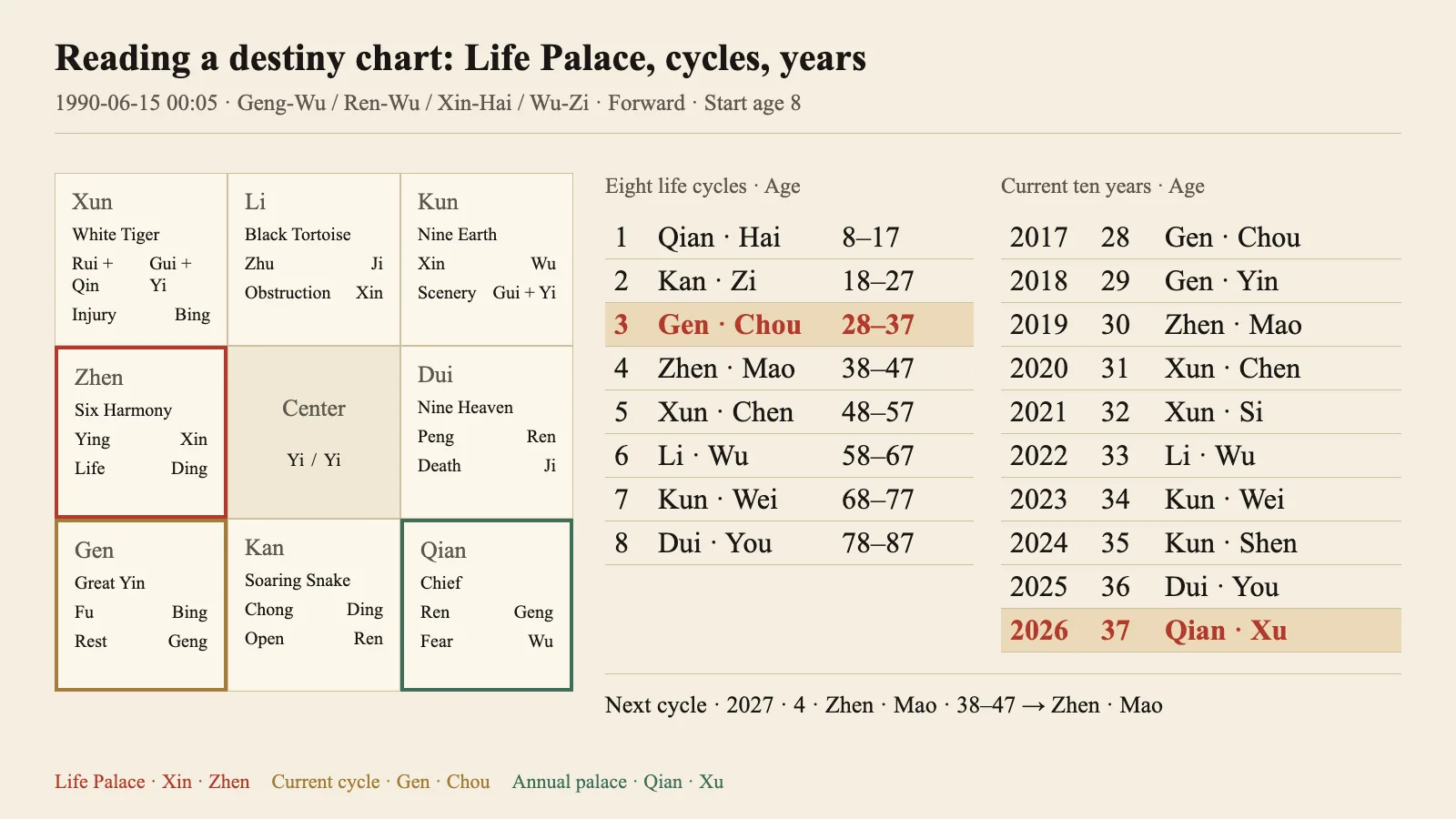
Chart cast on this site: birth-place clock time 00:05, 15 June 1990, Beijing, male, true solar time off, read for 2026.
The three layers of a destiny chart
When you cast a destiny chart on this site, it shows four things: the full nine-palace birth chart, the direction of the cycles and the age they start, the eight major life cycles, and the ten years inside the current cycle. The last item appears only once your cycles have started and while you are still within the eight cycles.
These four items belong to three layers:
- Birth chart: the nine-palace chart cast for your birth time, read for your long-term baseline. It never changes from year to year.
- Major life cycles: eight stages of ten years each, read for the theme of a period of life.
- Annual palaces: each year inside a cycle, read for what that year triggers.
The layers work on different time scales and cannot stand in for one another. A strong pattern in the birth chart does not make every year smooth, and one difficult annual palace does not overturn a whole ten-year cycle. How a destiny chart differs from an hour chart is covered in destiny chart vs hour chart. For a specific matter happening now, use an hour chart, one question per chart.
Check the birth details first
Every layer is derived from the birth time, so an error there carries through everything. Before casting, check three things: the clock time at the place of birth, down to the minute; gender; and whether to apply true solar time. This site casts the destiny chart from the birth-place clock time as entered, without converting it to Beijing time. True solar time is optional and off by default.
Uncertain birth times are common. The site does not currently offer an "unknown hour" option, and it does not rectify the birth time for you. If the time is only an estimate, especially near the boundary between two double-hours, the birth chart and every cycle after it may change. Keep that in mind as you read.
Step 1: Find the Life Palace in the birth chart
On this site, the Life Palace is the palace where the heaven-plate Day Stem falls; if the Day Stem sits in the center palace, the destiny-chart rule lodges it in Kun. Once you have the Life Palace, note where the birth chart's Yuan Shen palace, Chief Star and Tian Yi palace sit. In the site's method, the Life Palace, Yuan Shen, Chief Star and Tian Yi together form the long-term baseline. Describe this layer first so you do not mistake one year's events for a lifelong verdict.
Two common mistakes are worth avoiding here. The first is assigning each palace a fixed area of life, such as one palace always meaning marriage and another always meaning money. When this site's method looks at career, marriage or family, it looks for the relevant topic Useful God, the family relation and the Chief Star palace, not a fixed palace-to-topic map. The second mistake is predicting a specific event from a single symbol, for example seeing one inauspicious pattern and announcing trouble in a given year. Specific events need more layers of evidence, as explained below.
Step 2: Place the current life cycle by its starting age
The major life cycles follow a few fixed rules:
- Direction: decided jointly by the yin or yang of the birth-year stem, gender, and whether the birth chart is Yin Dun or Yang Dun. It is not decided by gender alone.
- Start: the first cycle begins in the palace of the Day Branch, and the starting age is found by counting from the Day Branch to the Year Branch. That is why the Life Palace and the first cycle are often in different palaces: the Life Palace follows the Day Stem, the first cycle follows the Day Branch.
- Age: all ages use traditional East Asian reckoning, with birth counted as age one, and the year changes at Li Chun (Start of Spring): the traditional age is the Li Chun year in question minus the Li Chun year of birth, plus one. The gap from your ordinary age is not fixed—your birthday and the date of each year's Li Chun both affect it—so do not simply add one; convert this way before matching an event to a cycle.
- Length: each cycle lasts ten years, and there are eight. They do not repeat after the eighth. Before the cycles start or after the eighth ends, the site does not show the current ten-year list.
With the current cycle located, read that palace's star, gate, spirit and stem pattern, then see how it relates to the Life Palace. That is the background theme for the ten years you are in.
Step 3: Read the ten years in the current cycle
Each time a new life cycle begins, the annual palaces restart from the actual branch of that cycle's palace, rather than continuing from the previous cycle. So your personal annual palace is not the same thing as the calendar year's stem and branch. 2026 is a Bing-Wu year for everyone, but one person's annual palace that year can sit in an entirely different palace.
For each year, the site labels its main relationship with the current cycle: same palace, opposite palace, three harmony, six harmony, earth trinity, combined force or clash. These mean that the year interacts with, strengthens or pushes the cycle; on their own they are neither good nor bad. Under the site's rules, in a destiny chart the annual palace carries more weight than the cycle, and the cycle more than the Chief Gate. Whether a relationship turns out well or badly depends on which palace it falls in and on that palace's stars, gates, spirits and patterns.
A complete worked example
Here is a destiny chart cast on this site: birth-place clock time 00:05 on 15 June 1990 in Beijing, male, true solar time off. The birth time is invented for demonstration and does not belong to a real person.
The birth chart's four pillars are Geng-Wu, Ren-Wu, Xin-Hai and Wu-Zi, in Grain in Ear, Yang Dun Ju 6. The Chief Star Tian Ren sits in Qian, and the Chief Gate (Life Gate) sits in Zhen.
| Item | Result |
|---|---|
| Life Palace | Heaven-plate Day Stem Xin falls in Zhen |
| Yuan Shen palace / Tian Yi palace | Gen / Kun |
| Direction | Forward (year stem Geng is yang, male, Yang Dun) |
| Starting age | 8 (counting forward from Day Branch Hai to Year Branch Wu) |
| 2026 | Traditional age 37; calendar year Bing-Wu |
| Current cycle | Third cycle, Gen Palace (Chou), ages 28–37, i.e. 2017–2026 |
| 2026 annual palace | Qian (Xu) |
The eight cycles run: Qian (Hai) 8–17, Kan (Zi) 18–27, Gen (Chou) 28–37, Zhen (Mao) 38–47, Xun (Chen) 48–57, Li (Wu) 58–67, Kun (Wei) 68–77 and Dui (You) 78–87. The first cycle starts in Qian, where the Day Branch Hai sits, while the Life Palace is Zhen.
The ten years in the current third cycle:
| Year | Age | Calendar year | Annual palace | Relationship to the current cycle |
|---|---|---|---|---|
| 2017 | 28 | Ding-You | Gen (Chou) | Same palace · Combined force |
| 2018 | 29 | Wu-Xu | Gen (Yin) | Same palace |
| 2019 | 30 | Ji-Hai | Zhen (Mao) | — |
| 2020 | 31 | Geng-Zi | Xun (Chen) | — |
| 2021 | 32 | Xin-Chou | Xun (Si) | — |
| 2022 | 33 | Ren-Yin | Li (Wu) | — |
| 2023 | 34 | Gui-Mao | Kun (Wei) | Opposite palace · Clash |
| 2024 | 35 | Jia-Chen | Kun (Shen) | Opposite palace |
| 2025 | 36 | Yi-Si | Dui (You) | — |
| 2026 | 37 | Bing-Wu | Qian (Xu) | — |
The relationship names are the ones the site shows on the chart. "Combined force" means the year reaches the cycle's own branch and reinforces the theme the cycle already has. "Clash" here means the year's Wei clashes with the cycle's Chou. For years with no relationship, the site notes that the year is read mainly from its annual palace.
Reading the chart in order:
- Baseline. The Life Palace is Zhen, with Xin on the heaven plate over Ding on the earth plate, Tian Ying star, Life Gate and Six Harmony. Note too that Yuan Shen is in Gen, the Chief Star in Qian and Tian Yi in Kun. Describe this layer before drawing conclusions.
- The current ten years. The third cycle falls in Gen, which is also the birth chart's Yuan Shen palace. These ten years therefore meet a foundational position of the birth chart. The meeting is not good or bad in itself; you still need to read Gen's stars, gates, spirits and patterns.
- Specific years. In 2017 the year shares the cycle's palace and reaches its own branch, the strongest meeting in these ten years. In 2023 the year sits in the opposite palace, Kun, and Wei clashes with Chou, meaning the existing balance gets pushed. Again, whether that is good or bad depends on the symbols in Kun and Gen. The 2026 annual palace is Qian, not Li where the branch Wu sits: a clear case of the personal annual palace differing from the calendar year.
- The next cycle. In 2027, at age 38, the chart enters its fourth cycle in Zhen (Mao), and the annual palaces restart from Mao instead of continuing on from 2026's Xu.
At this point, check the reading against experiences you can date with confidence, for example what happened around 2017 and around 2023. Use only events whose dates you are sure of, and do not go back and pick the ones that fit to prove the chart right.
Step 4: Recheck specific topics with the topic Useful God
For a specific question about career, relationships or money, use the cycle to set the stage, use the annual palaces to find the year that triggers it, and then return to that topic's Useful God: does the cycle form a relationship with the Useful God or the Day Stem, and does an annual palace set that relationship in motion? With no specific topic, treat the annual palace as the year's main focus.
Under the site's evidence standard, a specific event such as divorce, serious illness or major financial loss needs at least three layers of evidence: the topic Useful God or family relation, the cycle stage and an annual trigger. Without that, you can only speak about a broader life theme, not a specific event.
What a destiny chart can tell you
A destiny chart suits long-range questions: what your baseline is, what theme the current ten years carry, and which years concentrate change. It is not the tool for "will next week's interview go well?"—that belongs to an hour chart, one question per chart. Nor does it replace professional advice on health, legal or financial matters.
Casting the destiny chart, viewing the nine palaces, the eight cycles and the ten years of the current cycle are free on this site; the full AI reading is unlocked per chart, as described on the destiny chart page. If the chart structure is still unfamiliar, start with the three lines of San Yuan Qimen and how to read a Qimen chart.
FAQ
Should I read the Life Palace or the life cycles first?
Start with the birth chart and Life Palace for the long-term baseline, then the theme of the current cycle, then individual years. Reversing the order makes it easy to treat one year's events as a lifelong verdict.
Why don't the life cycles start at age one?
The starting age comes from counting the Day Branch to the Year Branch, so it differs from person to person. Before your cycles start there is no current cycle, and the site does not show the ten-year list.
How is the calendar year's stem and branch different from my annual palace?
The calendar year is the same for everyone—2026 is Bing-Wu for all. Your annual palace restarts from the branch of your current cycle, so where it lands differs from person to person.
Is a same-palace or clash relationship between a year and a cycle good or bad?
Neither by itself. Same palace, opposite palace, three harmony, six harmony, combined force and clash only show interaction, reinforcement or pressure. Whether it helps or hurts depends on the stars, gates, spirits and patterns of the palaces involved.
Why doesn't my destiny chart show the ten annual years?
The ten-year list appears only after your cycles have started and while you are still within the eight cycles. If they have not started yet, or you have passed all eight, this section does not appear.