How to Read Qi Men Dun Jia Directions Before a Trip: A Worked Example
A real chart, step by step: the client is to the northeast and you can leave at 9:30 or 13:30. How to measure the direction, compare gates, stars, deities and marks, and decide.
Measure the direction to your destination, cast a chart for each candidate time, and compare the gate, star, deity and marks in that direction. In this example the northeast holds the Life Gate with the Chief in the morning and the Death Gate with the White Tiger in the afternoon, so the morning wins.
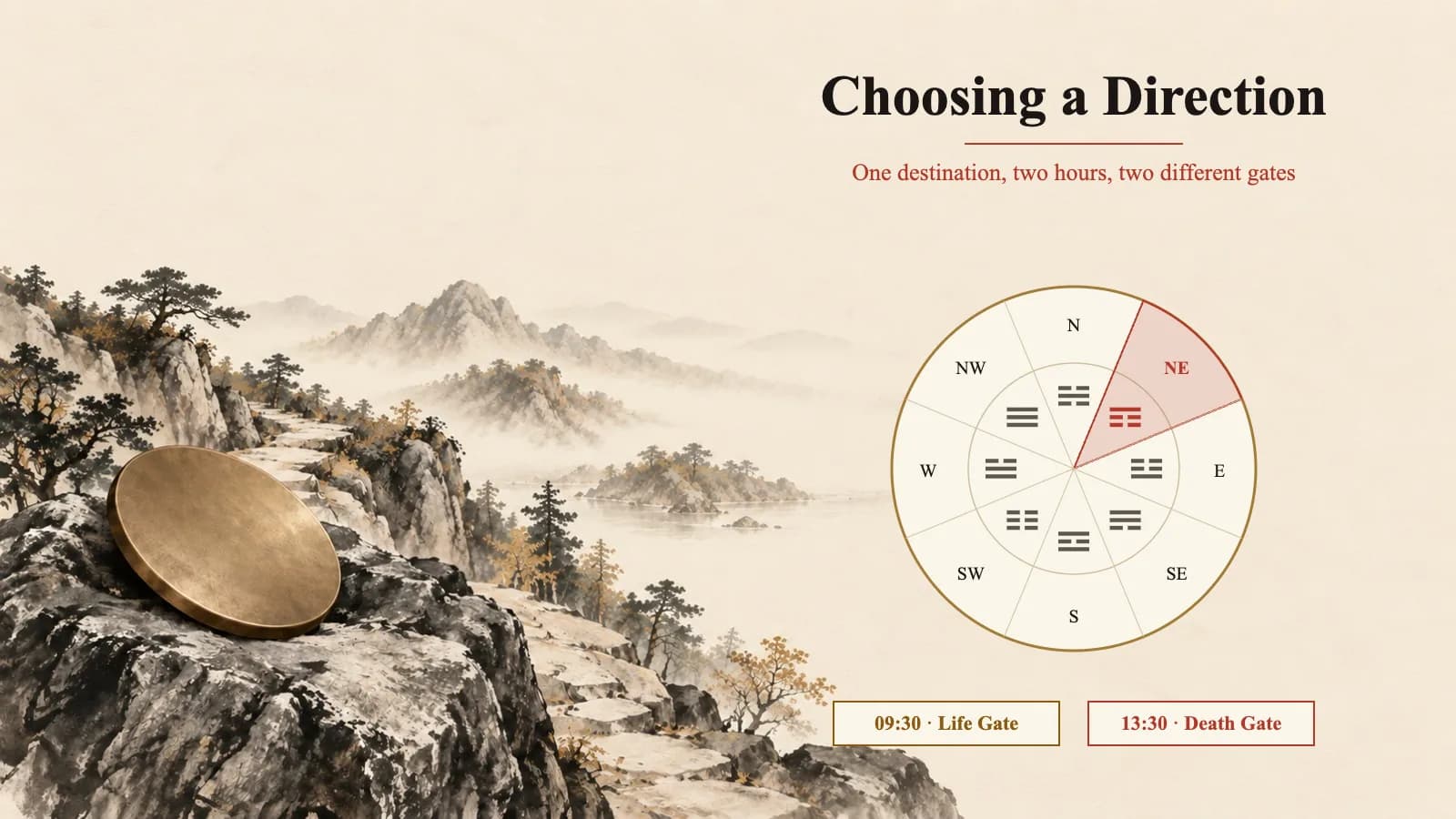
Most writing about Qi Men directions stays abstract. Real decisions are narrower: you have a client meeting tomorrow—do you leave in the morning or after lunch? This article walks through one real chart from start to finish. All chart data come from QimenMind, cast in Beijing time (UTC+8) with the Chaibu bureau method, a rotating plate, the centre palace lodged in Kun, and a day pillar that changes at 23:00.
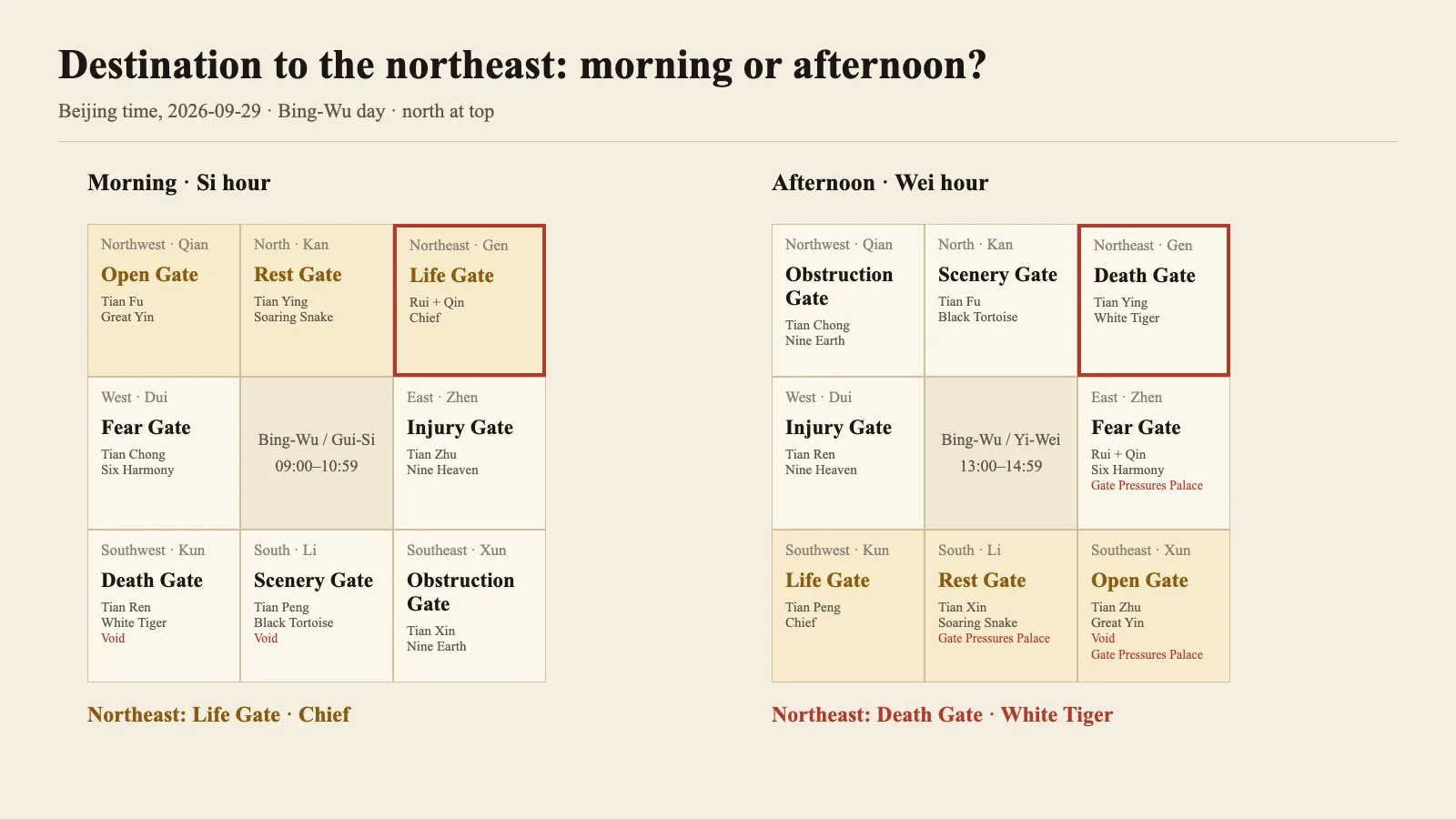
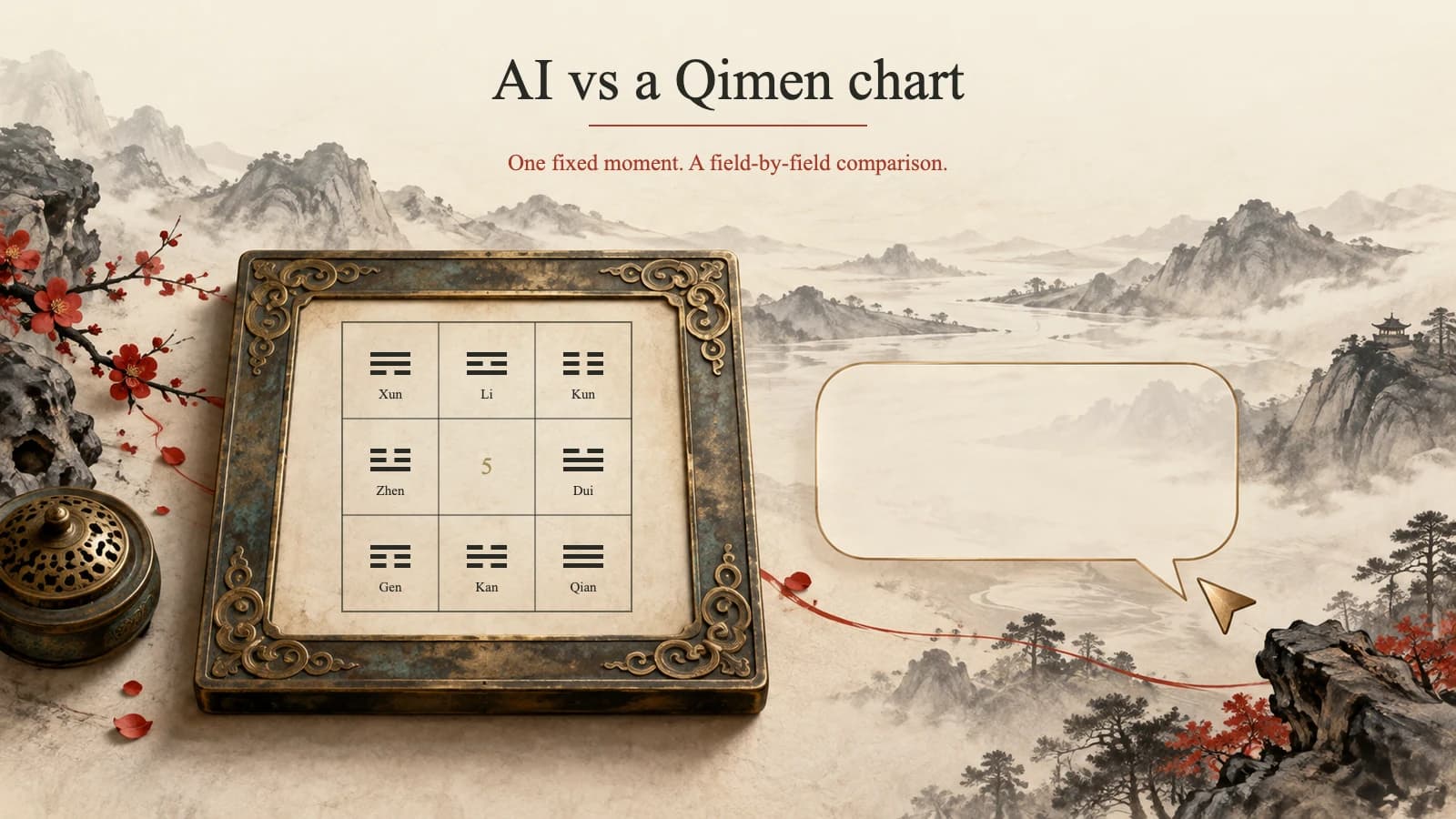
QimenMind chart data: the eight directions in the Si hour (09:00–10:59) and the Wei hour (13:00–14:59) of 2026-09-29, Beijing time. The northeast cell is the destination in this example.
The example: a Tuesday meeting to the northeast
Say that on Tuesday, 2026-09-29, you are visiting a client to discuss a partnership. Their office lies northeast of where you will start, about forty minutes away. Two departure times work for both sides: 9:30 in the morning or 13:30 after lunch. You want to compare them with Qi Men.
If you live in Singapore, Malaysia, Hong Kong, Taiwan or the Philippines, your clock already matches Beijing time. Elsewhere, convert your departure time to Beijing time first; the direction finder shows both clocks side by side.
Step 1: measure the direction to the destination
Measure from where you set out, not from a fixed home or office. Draw a line from start to destination and see which 45° sector its bearing falls in: northeast runs from 22.5° to 67.5°, east from 67.5° to 112.5°, and so on. A phone map compass or a bearing measured on a map is enough.
If the destination sits near a boundary—say 66°—check both neighbouring directions and only rely on the result if they agree. In this example the client's office is at about 45°, squarely northeast.
Step 2: cast a chart for each candidate time
9:30 falls in the Si hour (09:00–10:59) and 13:30 in the Wei hour (13:00–14:59). Both windows share the day pillar Bing-Wu and the bureau Yin Dun Ju 4 in the Autumn Equinox term. What differs is the hour pillar: Gui-Si in the morning, Yi-Wei in the afternoon. A new hour pillar moves the Chief Gate, and the gates, stars and deities all shift with it.
In the direction finder, choose 2026-09-29. The table shows where the three auspicious gates fall in both windows, and opening a row shows the gate, star and deity in all eight directions.
Step 3: compare the northeast in both charts
| Item | Si hour 09:00–10:59 | Wei hour 13:00–14:59 |
|---|---|---|
| Gate in the northeast (Gen) | Life Gate | Death Gate |
| Star | Tian Rui with Tian Qin | Tian Ying |
| Deity | Chief | White Tiger |
| Marks | Stem in Tomb, Punishment (secondary) | none |
| Auspicious gate directions | Open NW, Rest N, Life NE | Open SE, Rest S, Life SW |
In the morning the northeast holds the Life Gate under the Chief deity. The Life Gate stands for profit and business, and the Chief, first of the eight deities, is usually read as strong backing—a good fit for a partnership talk. The cell carries two secondary marks, Stem in Tomb and Punishment, which hint at delays or friction: prepare your materials fully and do not expect to close everything in one meeting.
In the afternoon the northeast holds the Death Gate under the White Tiger. The Death Gate is not used for auspicious aims, and the White Tiger points to conflict and loss. There is no Void or gate clash here, but neither the gate nor the deity suits a partnership talk. The afternoon's auspicious gates do not help either: the Open Gate in the southeast is Void and presses its palace, the Rest Gate in the south presses its palace, and only the Life Gate in the southwest is clean, with the Chief—but that is the wrong direction.
Step 4: decide, then put the chart back in context
On this comparison you leave at 9:30. The reasoning is simple: toward the destination, the morning offers the Life Gate and the Chief, the afternoon the Death Gate and the White Tiger, and both times are practical.
What if only the afternoon is possible? Do not drive southwest to catch the Life Gate and then double back; that costs time and changes nothing about the meeting. Directions only compare options you could already take, and traffic, weather, safety and the other person's schedule come first. If the afternoon is your only choice, prepare as usual and focus on the conversation. For a deeper look at this specific meeting, open the same hour in the current hour chart and ask Dunyuan about it; how to ask a Qimen question shows how to phrase it.
When neither time is good
Sometimes every candidate puts an inauspicious gate, a Void or a gate clash toward your destination. Work through the options in order: look for another practical time the same day and compare it; see whether the meeting place can move—another of the client's offices, or a café nearby—so the direction lands on a better gate; and if neither can change, accept the practical constraints and prepare well.
What not to do is leave hours early to wait around, or head off in another direction first and loop back. These make the trip more complicated without changing the direction from your starting point to the destination.
Keep a record of each comparison
If you plan to use Qi Men for scheduling over time, keep a short note each time: start and destination, bearing, candidate times, the gate, star, deity and marks toward the destination for each time, what you chose and why, and what actually happened. After a dozen entries you will see which marks matter for your kind of task and which are background—far more useful than remembering a few occasions when it "worked".
Return trips, distance and multi-stop journeys
The usual practice is to read the outbound trip to the place where the business happens; return journeys are not normally given their own chart. For a trip with several stops, each leg uses its own departure time and starting point.
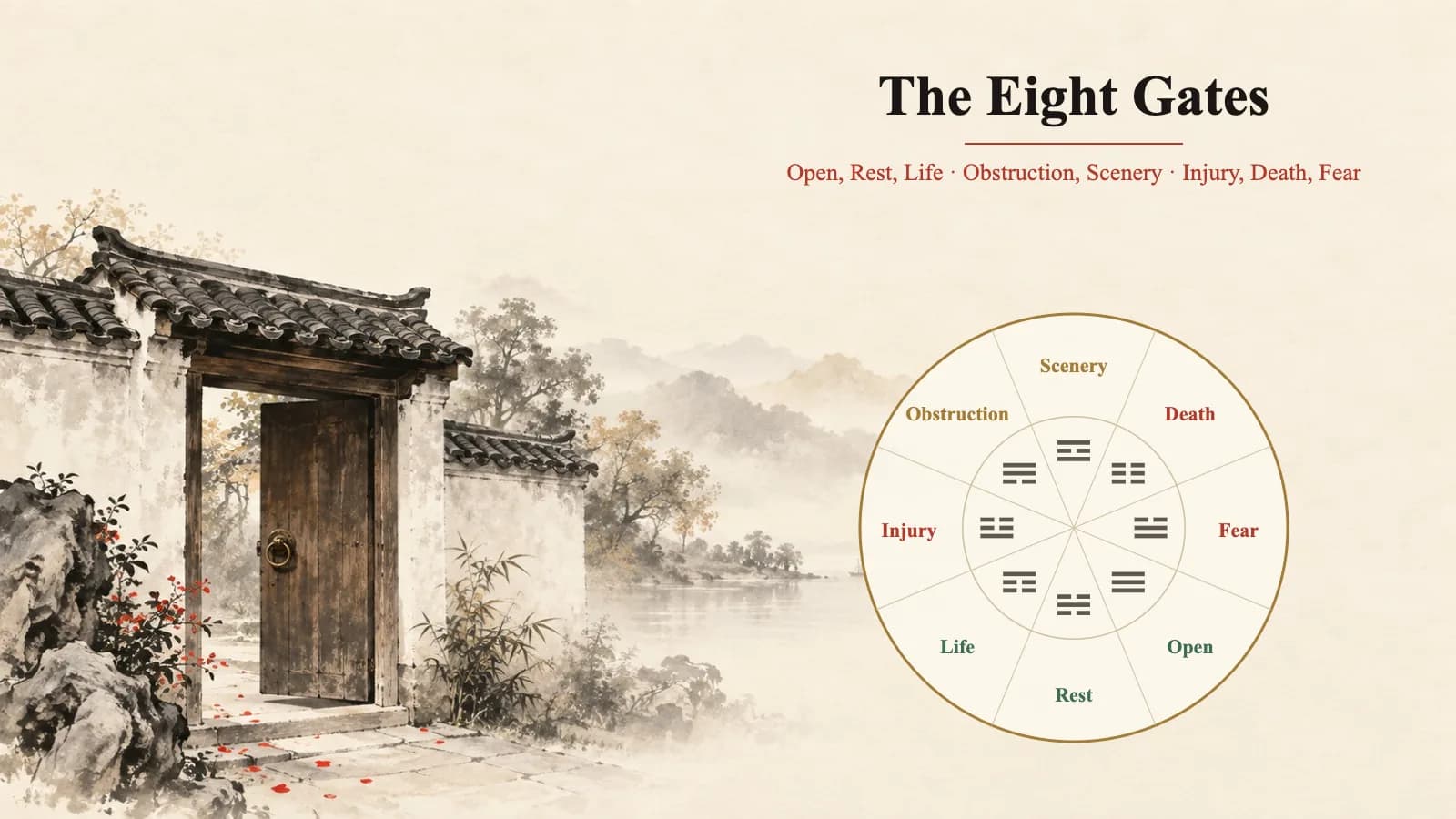
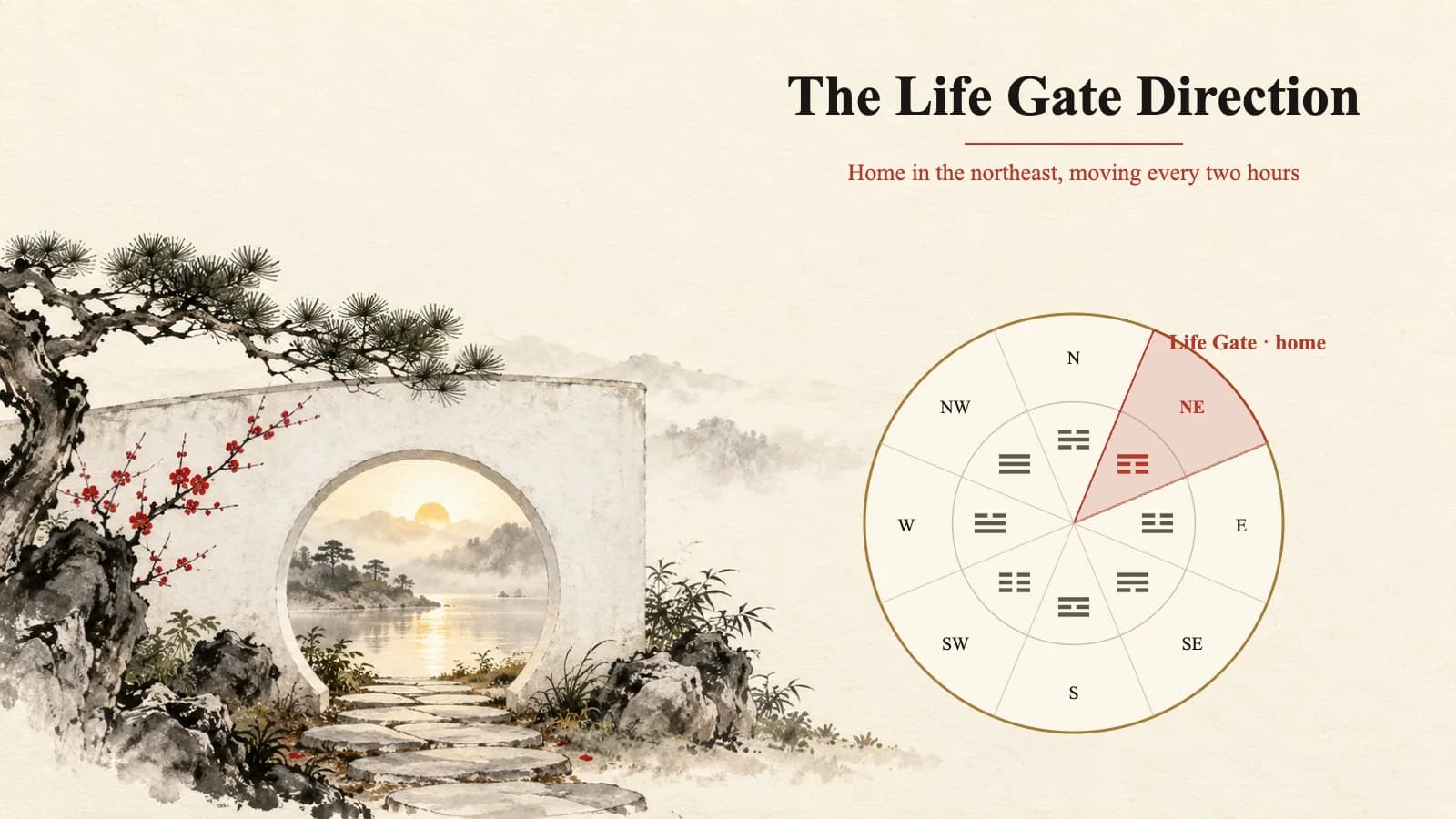
For very short moves within a few hundred metres, direction is not usually worth checking. For long journeys the direction is still the bearing from start to destination; the route you take does not change it. The gates have more uses than travel—money questions also look at Wu, job questions at the Open Gate and your own palace. For the meanings of each gate, read the eight gates and their directions and the Life Gate direction.
When not to rely on directions
For medical needs, emergencies or anything involving personal safety, do not wait for a good direction and do not delay because of a poor one. Qi Men directions suit situations where you have several acceptable options and want the smoother one; they do not replace judgement or professional advice.
FAQ
I only have one possible time. Is a direction reading still useful?
A little. With one time, the reading works as a reminder: if the gate or deity toward your destination is poor, prepare more and leave room for delays, rather than changing something you have to do.
My departure and my meeting fall in different hours. Which one counts?
Usually the departure. If the two are far apart—leaving the night before for a morning meeting, say—cast the meeting hour as well and read both.
What if the destination sits on the boundary between two directions?
Check both. Rely on the result when both directions suit the task; if they conflict, give more weight to the direction closer to the bearing, or choose a time that suits both.
Does a winding route change the direction?
No. The direction is the bearing from start to destination, not the route. There is no need to take a detour to catch an auspicious direction.