Exams in Qi Men Dun Jia: Reading the Scenery Gate and Your Palace
For exam questions, Qi Men Dun Jia reads the Scenery Gate first. Learn the order for tests, admissions and certifications: check the gate's strength, Void and tomb marks, compare its palace with your Day Stem palace, and add the Open Gate when a post or a school place is at stake. With a worked chart.
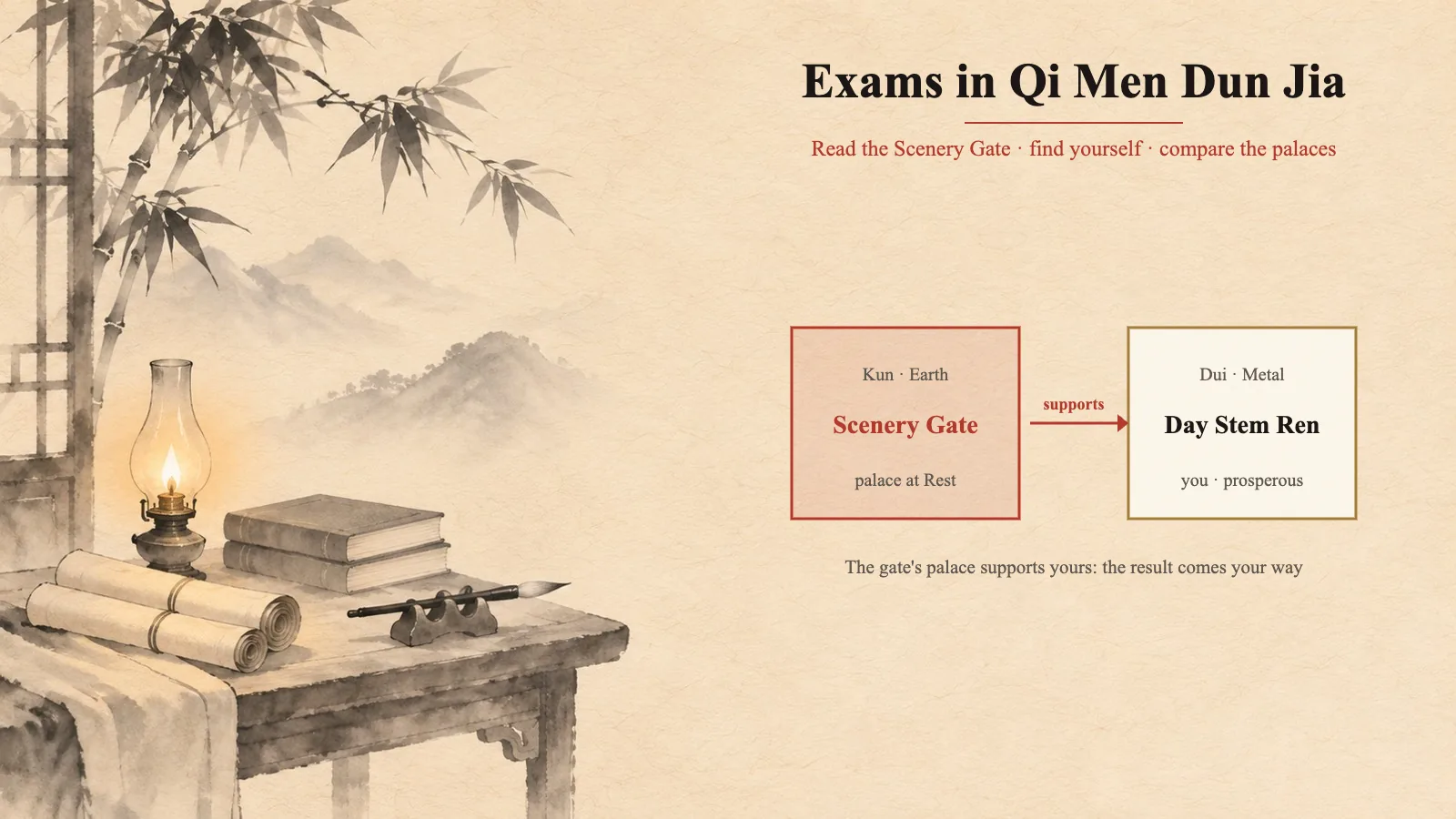
For exams, read the Scenery Gate first: strong means good form, Void means a result in name only, Fu Yin means the study is not going in. Then compare its palace with your Day Stem palace; if it supports yours, the result comes your way. Add the Open Gate for civil service posts and admissions. Before and after the exam are read differently.
For exams, admissions and certifications, Qi Men Dun Jia reads the Scenery Gate (景门, Jing Men) first among the eight gates. The Scenery Gate covers documents, writing and examinations, so it represents the exam and your paper. Its condition alone is not enough. You also need your Day Stem palace, which stands for you, to see how the Scenery Gate's palace relates to it; that decides whether the result reaches you. Then check whether the gate is Void, pressured or in a tomb, and, when a civil service post or a school place is the real goal, read the Open Gate as well. A chart shows a state and a leaning. It does not replace revision.
Why the Scenery Gate for exams
Each gate covers a kind of affair: the Open Gate covers career and position, the Life Gate covers business and returns, and the Scenery Gate covers documents, writing, information and exams. So for "Will I pass this exam?", "Do I have a chance at graduate school?" or "Is this the year to sit the certification?", the key symbol is the Scenery Gate. All eight are described in the eight gates of Qi Men Dun Jia.
The Scenery Gate has two faces: brilliance and display, and also show without substance. In an exam question it leans positive, but its state in the palace has to be read; the gate's presence alone is not good news.
Classical texts also consult the star Tian Fu and the stem Ding for documents and exams. This site takes the Scenery Gate as the main symbol, and this article follows that line only.
Step 1: the state of the Scenery Gate
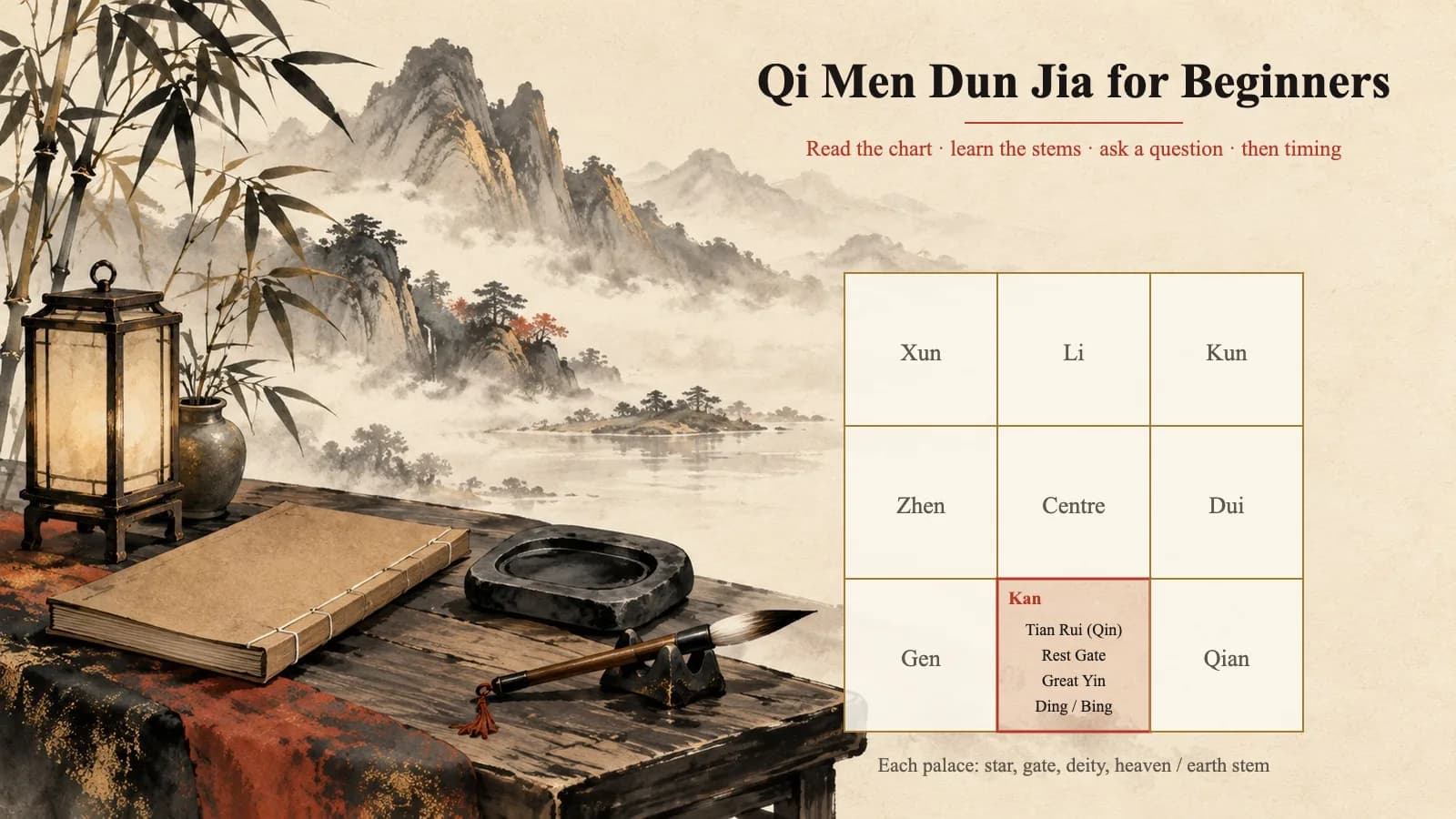
Find the Scenery Gate's palace and check:
- Strength. A strong Scenery Gate means good form and the ability to perform; a weak one means low form.
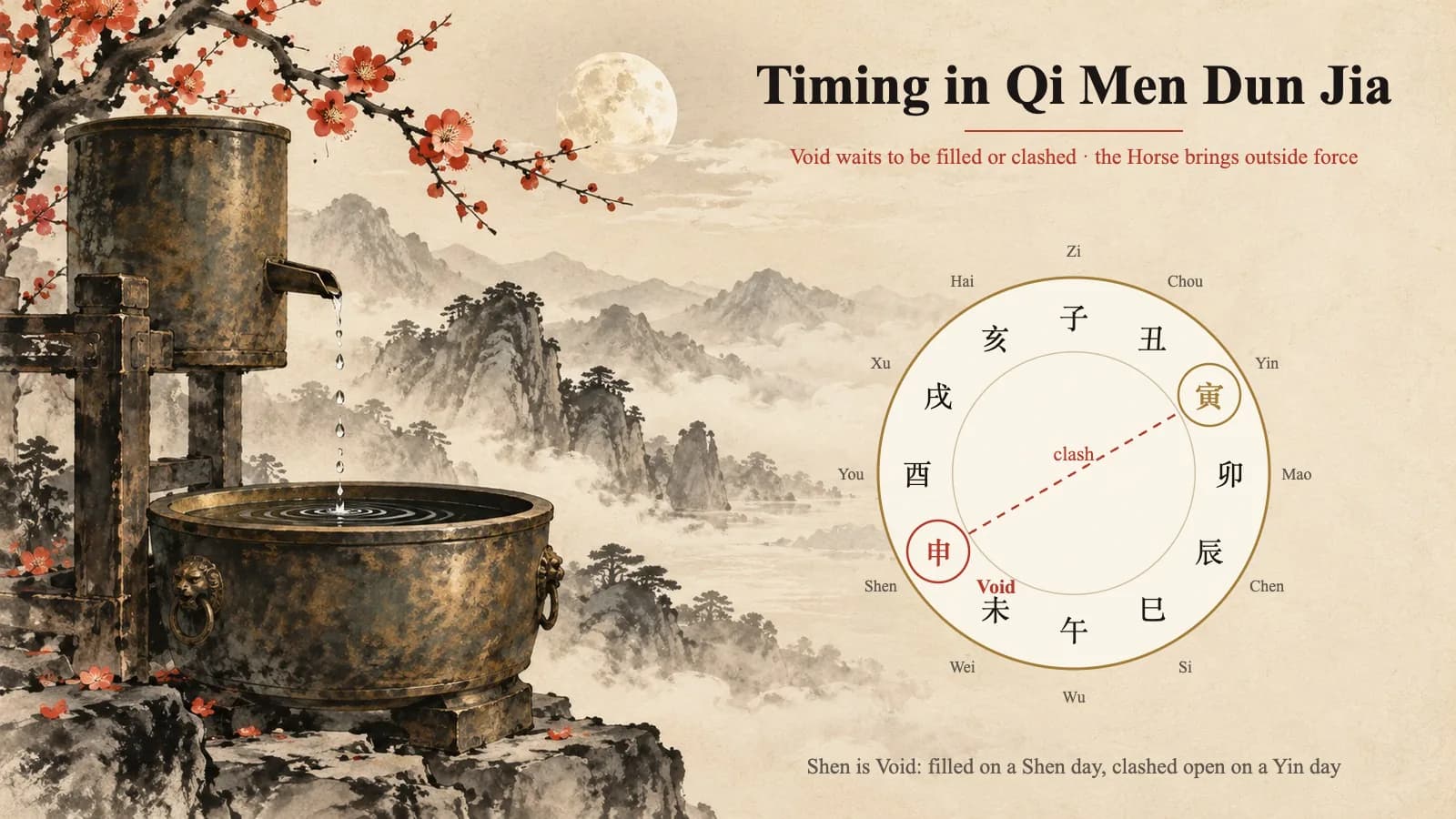
- Void. A Scenery Gate in Void is a result in name only: it felt like a good paper, but nothing lands. When it becomes real is covered in timing in Qi Men Dun Jia.
- Pressure marks. The Scenery Gate is Fire. In Qian or Dui it is Gate Pressures Palace; in Kan it is Palace Restrains Gate. Either way performance is discounted.
- Tomb. Strength is held in, often read as knowing the material but being unable to get it onto the page, or a result that is held back.
- Fu Yin. A whole chart in Fu Yin tends toward standing still: the study is not going in and revision is not progressing.
The palaces where each gate takes these marks are listed in the table in the eight gates article.
Step 2: compare the Scenery Gate's palace with yours
A Scenery Gate in good condition only means the exam itself looks manageable. Whether the result is yours depends on the five-element relationship between its palace and your Day Stem palace. The table lists the three most common cases:
| Relationship | Common reading |
|---|---|
| The Scenery Gate's palace supports yours | The result comes your way; the exam favours you |
| Same element | Steady, with no clear push or obstacle |
| The Scenery Gate's palace restrains yours | The exam bears down on you; hard going, hard to perform |
Other cases, such as your palace supporting or restraining the gate's palace, depend on the kind of exam and the stage you are at, and cannot be reduced to one line. The full reading order is in how to read a Qimen Dunjia chart.
Posts and admissions: add the Open Gate
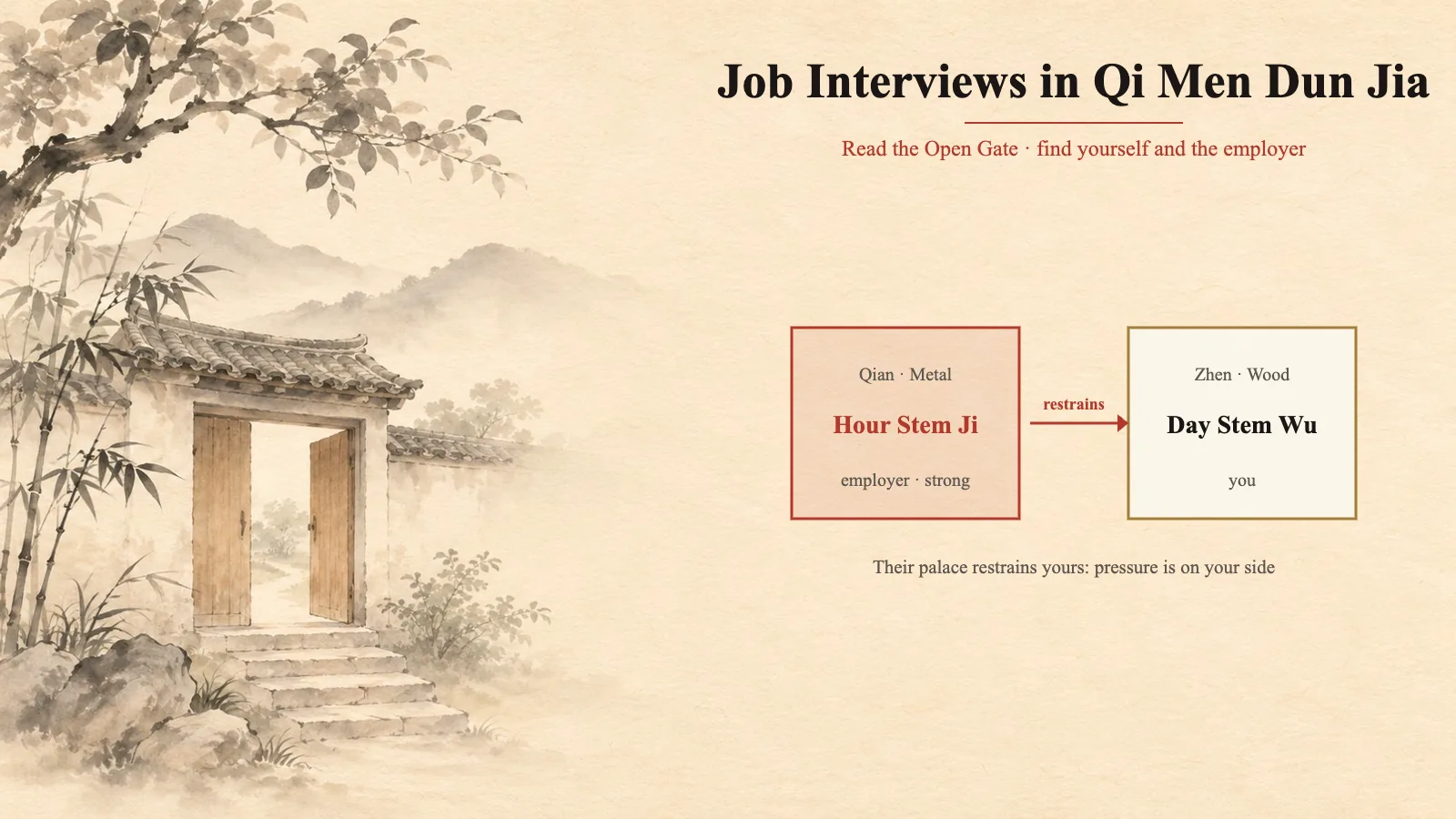
When the exam is only the first hurdle, read the Open Gate too. The Open Gate covers positions and institutions: for a civil service or public-sector exam it stands for the post; for a school application it stands for the school. A good Scenery Gate with a poor Open Gate often means the written test goes well and the interview or the offer does not; the reverse means a suitable post let down by the paper. Reading the Open Gate is covered in job interviews in Qi Men Dun Jia.
Before and after the exam
Before the exam, the question is how to prepare and whether you can pass. Afterwards, while waiting, it is what the result will be. The two are read from different clues. That part belongs to this site's lineage method. The AI reading applies it to the stage you describe, and it is not set out here.
When you ask, say which exam it is, whether you have sat it, how long is left if you have not, and which part you are least sure of. See how to ask a Qimen question.
A worked chart from this site
The chart below is calculated live by this site's chart component for 11:00 Beijing time (UTC+8) on 4 November 2026: pillars Bing Wu, Wu Xu, Ren Wu and Bing Wu, Frost Descent, Yin Dun Ju 5 (upper yuan). The question is a teaching assumption: someone asks, "Will I pass my qualification exam next month?" You can also open the same chart in the calculator.
Tap a card to see it on the chart. Tap again to close.
Useful God (Yong Shen)
| Item | Chart |
|---|---|
| Scenery Gate | In Kun (Earth), palace at Rest; with Tian Xin and Soaring Snake, heaven stem Yi, earth stem Xin |
| State of the Scenery Gate | No Void, no Gate Pressures Palace, no Gate in Tomb; the heaven stem Yi in the same palace is in its tomb |
| Day Stem (you) | Ren, in Dui (Metal), palace Prosperous |
| Relationship | Kun Earth supports Dui Metal: the Scenery Gate's palace supports yours |
| Open Gate | In Kan (Water), palace Gestating |
Read in order: the Scenery Gate is not Void and not pressured, so nothing obvious stands in the way of the paper itself; its palace, Kun, is at Rest, so the force behind it is moderate. Its palace supports yours, the image of the result coming your way, and your palace is Prosperous, so you can receive it. Two things count against it: the heaven stem Yi in the gate's palace is in its tomb, and Soaring Snake shares the palace, which suggests a part of the process that is stuck or goes round in circles, such as one subject you keep being unsure of.
On these layers alone, the leaning is favourable, provided the uncertain part is fixed. The question here is a qualification exam with no admission stage, so the Open Gate is listed but not developed, and the main lines and the timing have not been read. The example only shows how to find the Scenery Gate, find yourself and compare the palaces.
Common mistakes
- A strong Scenery Gate means a pass. It only means good exam form. Whether the result reaches you depends on its relationship with your palace.
- Reading the Scenery Gate and ignoring the Open Gate. For civil service posts and school applications, the offer is in the Open Gate.
- Casting charts instead of revising. A chart cannot say which question will come up. It points to your state and your weak spot.
- Casting again and again before the result is out. If nothing has changed, keep asking on the original chart.
Reading exam questions on this site
Enter a time in the calculator to see where the Scenery Gate, the Day Stem and the Open Gate sit and each palace's state. For a full reading, use Dunyuan's AI reading and say which exam it is and whether you have sat it.
FAQ
Which gate does Qi Men Dun Jia read for exams?
Mainly the Scenery Gate. It covers documents, writing and examinations and is the key symbol for tests, admissions and certifications, read together with the Day Stem palace that stands for you.
What does the Scenery Gate in Void mean?
A result in name only: you feel you did well and nothing lands, or the score comes out and the place or certificate does not follow.
How are civil service and public-sector exams read?
Read the Scenery Gate and the Open Gate together. The Scenery Gate covers the written test and your paper; the Open Gate covers the post and the offer. Both need to be good for a smooth result.
Can Qi Men Dun Jia tell me what questions will be on the paper?
No. A chart does not give questions. It can point to your state, the part most likely to trip you up, and the general leaning.
I failed and want to resit. When is a good time?
That is a timing question. First see where the obstacle was in this chart, then when that obstacle is released. You can keep asking Dunyuan on the same chart.