Love and Reconciliation in Qi Men Dun Jia: Six Harmony, Your Palace and Theirs
For a relationship question, Qi Men Dun Jia reads Six Harmony first, then your Day Stem palace and the other person's Hour Stem palace: who supports whom, who presses whom, and whether any of them is Void or in a tomb. For reconciliation, state the stage you are in. With a worked chart.
For love, find Six Harmony first; it shows whether the connection is still there. Then compare your Day Stem palace with the other person's Hour Stem palace to see who is giving and who is pressing, and check Void and tomb marks. For reconciliation, say how long you have been apart and whether you are in contact.
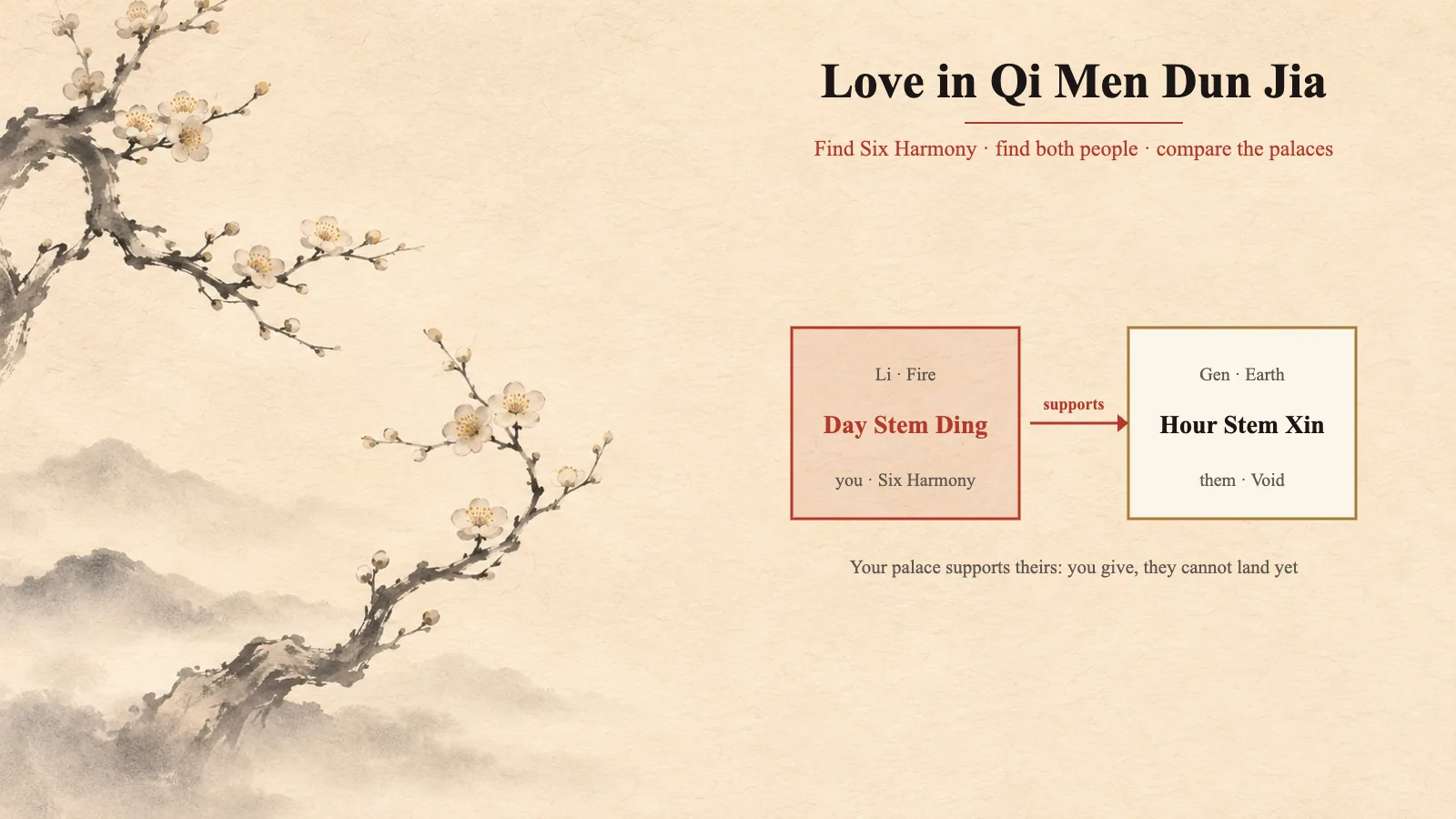
For a relationship question, Qi Men Dun Jia looks first for Six Harmony (六合, Liu He) among the eight deities. Six Harmony stands for union, marriage and the go-between, so it represents the relationship itself and whether the two of you are still connected. That alone is not enough. You also need your Day Stem palace, which stands for you, and the Hour Stem palace, which stands for the other person, to see who supports whom and who restrains whom; then check whether any of these palaces is Void, in a tomb or under pressure. A chart shows the direction and strength of a relationship. It does not quote the other person's thoughts, and it cannot decide for you whether to continue.
Why Six Harmony comes first
Each of the eight deities covers something. The Chief covers rank and the lead; Soaring Snake, entanglement and going back and forth; Great Yin, what is hidden; Six Harmony, union and connection; White Tiger, conflict and decisiveness; Black Tortoise, concealment and things left unclear; Nine Earth, stability and stillness; Nine Heaven, distance and change. For love, marriage or getting back together, the symbol for the relationship itself is Six Harmony.
Six Harmony answers one thing: is there still a line between you? It does not describe each person's own state. Being able to meet and talk does not mean both people can carry the relationship. So the two palaces must be read as well.
Some classical texts read the woman and the man from the stems Yi and Geng. This site uses the Day Stem palace for you and the Hour Stem palace for the other person as the default for all question types, adjusted to each person's role in the question.
Step 1: find Six Harmony, yourself and the other person
Find the palace holding Six Harmony, then the palaces of the Day Stem and the Hour Stem. When either stem is Jia, look for the stem it hides under; the chart on this site marks the converted Day and Hour Stems for you.
Start with where Six Harmony sits:
| Six Harmony is | Common reading |
|---|---|
| In your palace | The connection is on your side; you are the one keeping it alive |
| In the other person's palace | The connection is on their side; they are still holding the line |
| In a third palace | The relationship is a thing apart from both of you; read how it relates to each side |
This layer only shows where the connection is. It does not show the outcome.
Step 2: compare your palace with theirs
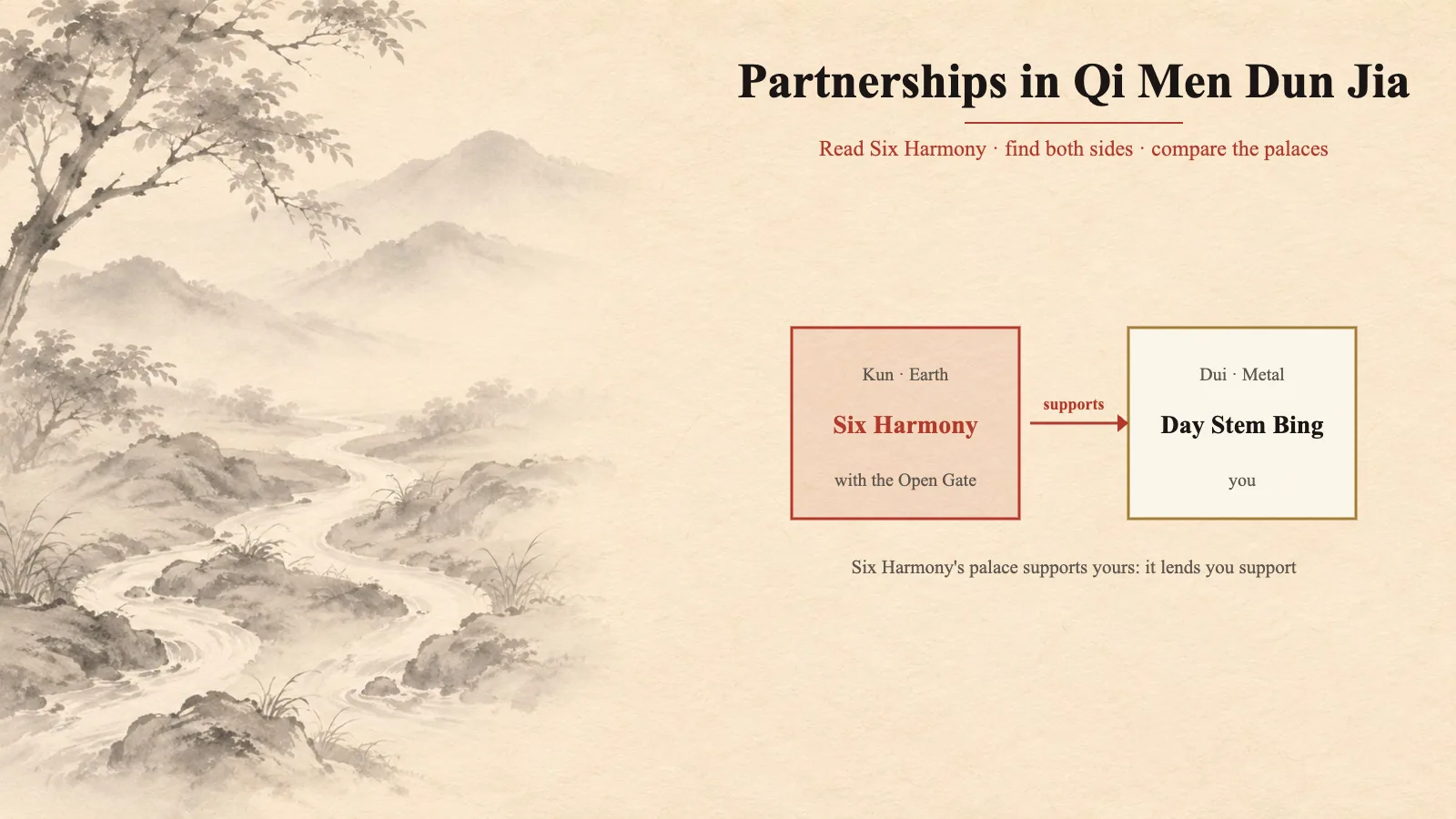
The five-element relationship between the two palaces is the clue to who is giving and who is pressing. Call your side A and the other side B:
| Relationship | What it lets you discuss |
|---|---|
| A supports B | You are giving |
| B supports A | They are offering support or care |
| A restrains B | You are making demands or holding on |
| B restrains A | They are a source of pressure or limits for you |
| Same element | Both are in the same state; this site often reads it as a standoff |
Direction is not the whole picture; the side that acts also needs strength. A weak side supporting a strong one often means wanting to give without having much to give. A weak side restraining a strong one can mean wanting to draw closer rather than dislike. The full comparison runs across four layers and is explained in who needs whom more.
Step 3: check Void, tomb and the other marks
With the three positions found, check each one:
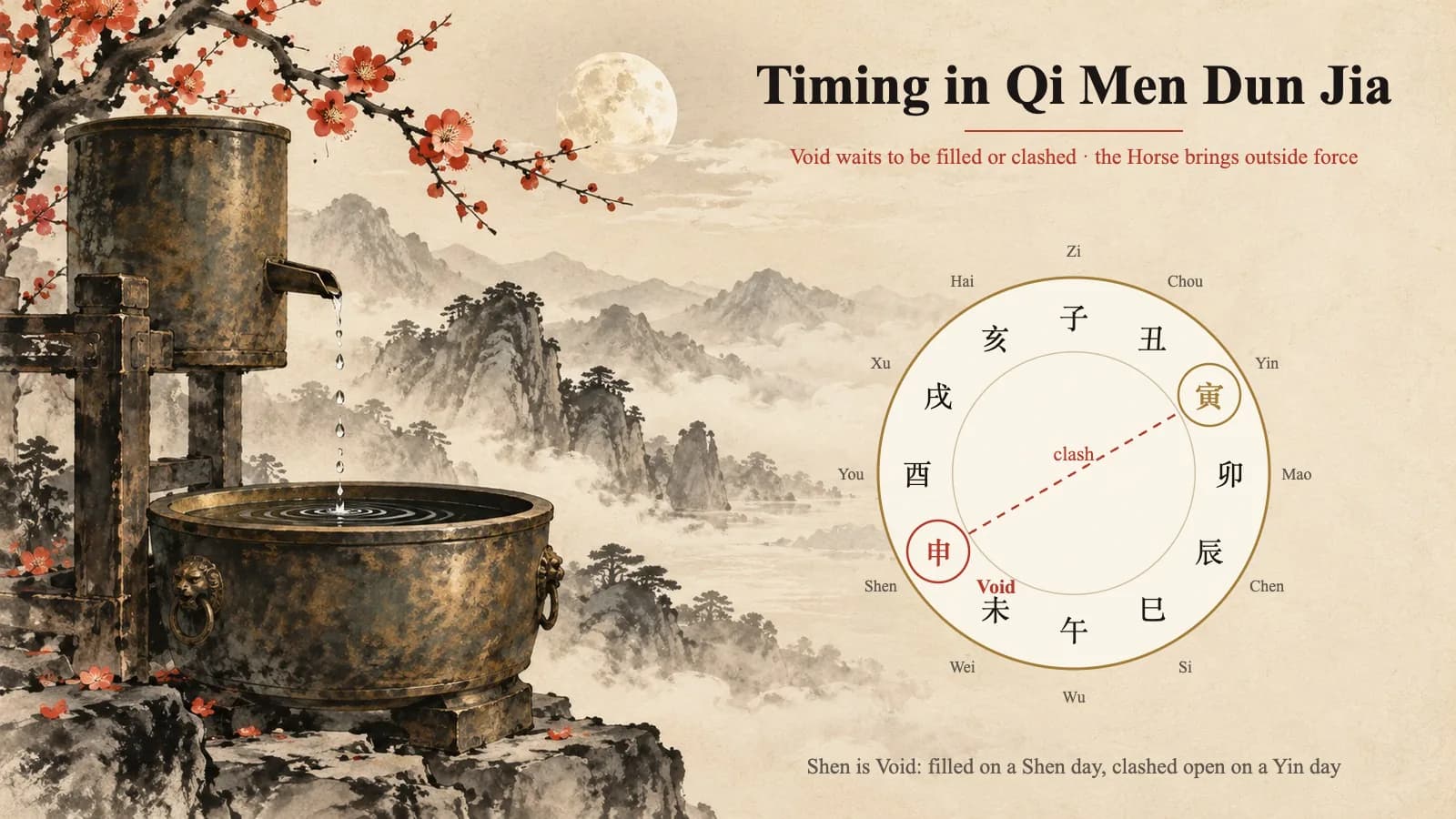
- Void. Whichever side's palace is Void cannot yet follow through: words without action. Six Harmony in Void is a relationship in name only. Void is not permanent; when it fills or is activated is covered in timing in Qi Men Dun Jia.
- Tomb. Strength is held in. Six Harmony in a tomb is commonly read as feelings that are stuck and cannot move.
- Palace Restrains Gate and Gate Pressures Palace. The person in that palace is hampered and cannot act freely.
- The deity in the palace. Soaring Snake in the other person's palace points to indecision; Black Tortoise, to something unsaid; Nine Heaven, to distance or an unsettled state. These are prompts to check against reality.
- Fu Yin and Fan Yin. Fu Yin tends toward standing still; Fan Yin toward back-and-forth. For someone pursuing a person, Fu Yin means it will not move; for an established couple, Fu Yin is steadiness.
For reconciliation, state the stage first
"Can we get back together?" is read differently a week after a breakup and two years after, and differently when you are still in touch than when contact has stopped. That part belongs to this site's lineage method. The AI reading applies it to the situation you describe, and it is not set out here.
When you ask, include four things: whether you are together, not speaking or apart; for how long; when the last contact was and who started it; and what you plan to do (reach out, meet, or wait). See how to ask a Qimen question.
A worked chart from this site
The chart below is calculated live by this site's chart component for 21:00 Beijing time (UTC+8) on 9 November 2026: pillars Bing Wu, Ji Hai, Ding Hai and Xin Hai, Start of Winter, Yin Dun Ju 9 (middle yuan). The question is a teaching assumption: someone asks, "We have been apart for a month and I want to reach out. Will they respond?" You can also open the same chart in the calculator.
Tap a card to see it on the chart. Tap again to close.
Useful God (Yong Shen)
| Item | Chart |
|---|---|
| Six Harmony | In Li (Fire), the same palace as the Day Stem; with Tian Chong and the Obstruction Gate, heaven stem Ding, earth stem Wu |
| Day Stem (you) | Ding, in Li; palace Confined |
| Hour Stem (the other person) | Xin, in Gen (Earth); palace Gestating; with Tian Xin, the Rest Gate and Nine Earth |
| State of their palace | Void for the hour (Yin and Mao are Void, which includes Gen); the Rest Gate in Gen is Palace Restrains Gate |
| Relationship | Li Fire supports Gen Earth: your palace supports theirs |
Read in order: Six Harmony shares the Day Stem's palace, so the connection is on the asker's side; they are the one keeping it going. Your palace supports theirs, so you are the one giving, and since your palace is Confined, this is wanting to give without much to give. Their palace is Void and restrained, so on their side nothing can land yet; even a reply is unlikely to turn into action soon.
On these layers alone, the leaning is: the message can be sent, but do not expect a clear answer right away. When the Void fills and where the relationship goes next have not been read here, and neither have the main lines or the timing. The example only shows how to find Six Harmony, find both people and compare the palaces.
Common mistakes
- Six Harmony means there is love and it will work out. It only shows whether the connection exists. The outcome depends on both palaces and their states.
- "Restrains" means they dislike me. Restraint is pressure or demand; weak restraining strong is often a wish to be close.
- Void means no chance. Void means it cannot land now; look at when it fills.
- Using the chart to decide there is a third person. Black Tortoise and Great Yin only suggest something unsaid. They are not grounds for accusing anyone.
- Casting the same question again and again. If nothing has changed, keep asking on the original chart.
Reading love questions on this site
Enter a time in the calculator to see where Six Harmony, the Day Stem and the Hour Stem sit, along with Void and each palace's state. For a full reading, use Dunyuan's AI reading and describe the current stage and what you plan to do. More ways to phrase relationship questions are in Qimen Dunjia for love and relationships.
FAQ
What does Qi Men Dun Jia look at for love?
Six Harmony first, for whether the relationship is connected; then the Day Stem palace (you) and the Hour Stem palace (the other person), and whether these palaces are Void or in a tomb.
Can Qi Men Dun Jia read reconciliation?
It can read the leaning: whether the connection remains, each person's state, and who has more strength to move things. Say how long you have been apart, whether you are in contact and what you plan to do. A chart cannot promise that someone will come back.
What does Six Harmony in Void mean?
A relationship in name only: it still exists on paper or in words, but nothing lands for now. The moment the Void fills or is activated is often when things change.
Black Tortoise is in their palace. Is there someone else?
That cannot be concluded. Black Tortoise covers concealment and things left unclear. It suggests something unsaid, which may be a worry or another plan. It is not evidence against a particular person.
Can Qi Men Dun Jia tell me what they are thinking?
Not directly. The chart shows each person's state, who is giving and who is pressing. Those are clues to an attitude, to be checked against what the person actually says and does.