Master Zuoye (Dunjia Jizhang)
Qi, Shi, and Xiang in Qi Men Dun Jia: Substance, Momentum, and Manifestation
Master Zuoye explains the three-layer San Yuan Qi Men Dun Jia model—Qi as substance, Shi as directional gradient, and Xiang as manifested outcome—illustrated with a six-step reading of Ren over Wu in Zhen.
A Qi Men Dun Jia chart maps a field of energetic tendencies rather than fixed fate: Qi defines substance, Shi defines gradient and direction, and Xiang reveals the resulting range of forms anchored by the question's focus.
A Qi Men Dun Jia chart does not simply announce that a fixed event is guaranteed to happen on a single day. Instead, it maps a field of energetic tendencies. Translating that field into concrete events and images requires analogical mapping, contextualizing by time, place, and person, and watching how motion triggers change.
1. Qi as Substance, Shi as Function, Xiang as Manifestation
- Qi (Substance): What material or intrinsic quality is present.
- Shi (Momentum / Gradient): The differential between Qi states—why movement occurs and which direction it leans toward.
- Xiang (Manifested Image): The visible trace or shape that emerges once Qi moves along Shi.
Qi
Qi consists of primordial Qi and differentiated Qi. Once primordial Qi settles into the nine-palace framework of Qi Men Dun Jia, it differentiates into Yin-Yang and Five-Element palace qualities that form the background canvas. Stars, Gates, Deities, and the Three Wonders and Six Instruments all act as vessels carrying Qi. The Five Elements are simply a classical taxonomy for five basic qualities, functions, and relational tendencies of differentiated Qi.
Shi (Momentum and Gradient)
Shi is the differential, gradient, and directional bias of Qi inside a given spacetime and relational field—shaped by seasonal strength, palace elements, generating and controlling interactions, Void (Kongwang), and the Travel Horse (Yima). The inquiry topic and focal significator (Yongshen) act as the reference frame. Where Qi is completely uniform within a frame, there is no Shi; only a difference creates motion.
Think of water: an elevation gap produces downward flow. Shi is a gradient in a field of conditions—it makes some trajectories far more probable than others, without forcing a single rigid track. Just as gravity directs water downhill while terrain, volume, and obstacles decide the river's actual shape, Shi sets directional constraints rather than a single pre-scripted path.
Interactions and triggers among the nine palaces make these Qi differentials concrete. Generation yields smooth momentum; control produces resistance; equality lacks an outward push (though two strong palaces of the same element can gather in resonance). Yet generation and control alone only state direction—whether an outcome is favorable depends on the inquiry focus, strength, and significator. Shi cannot exist apart from Qi.
Xiang (Manifestation)
Xiang is the trace, sign, and distribution of outcomes produced as Qi moves along Shi. It is never a single pre-written sentence, but a cluster of related possibilities. Reading Xiang means filtering overlapping imagery through the topic, significator, strength, interactions, and stem formations to identify the most probable real-world state.
2. Six-Step Walkthrough: Ren over Wu in Zhen for Tomorrow's Job Question
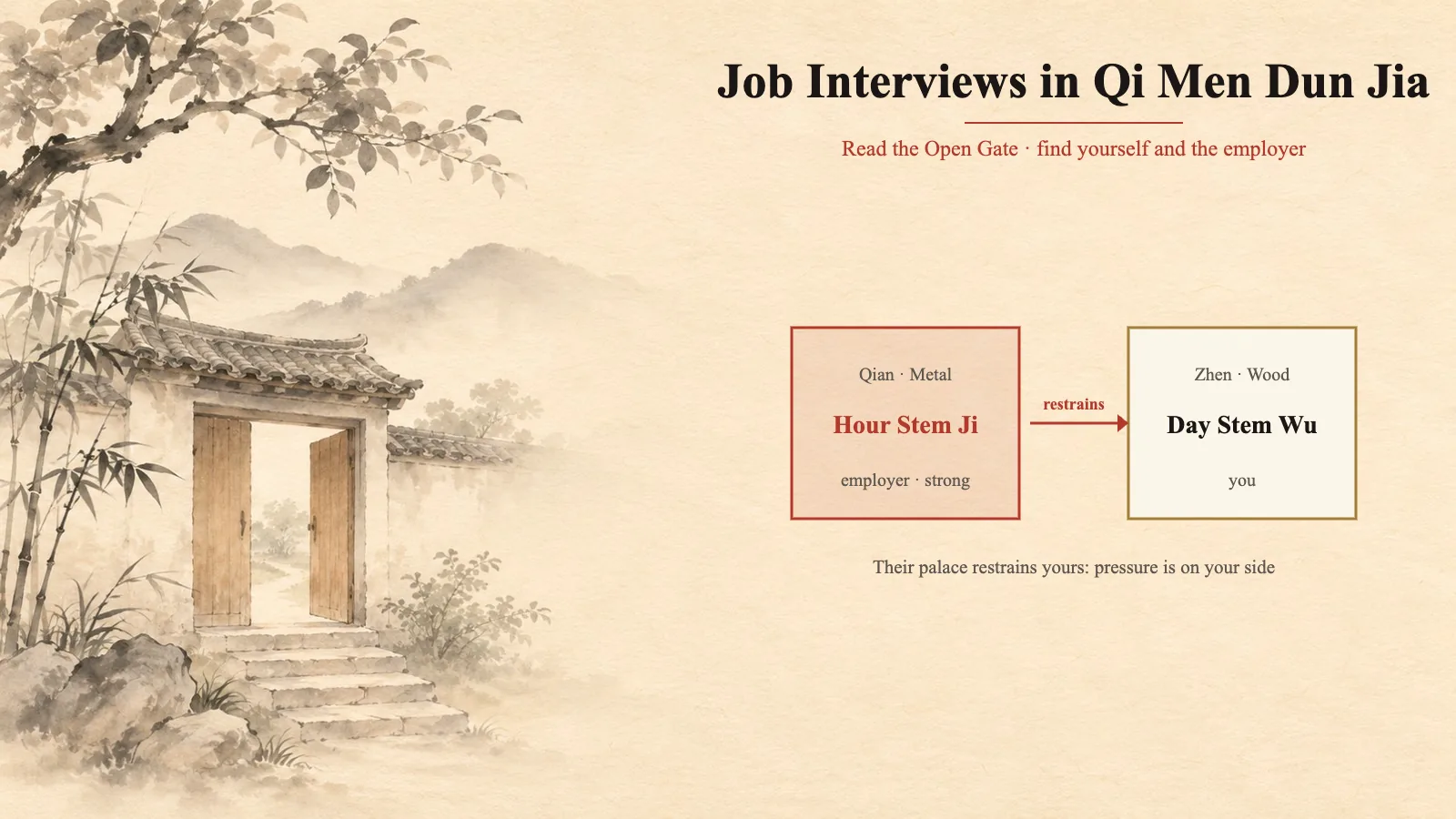
Suppose the advancing palace triggers Ren over Wu in the Zhen (East) palace when someone asks whether tomorrow's job interview or work matter will succeed.
Step 1: Identify the Qi of Ren and Wu
- Ren (Water): Movement, change, risk, intellect, concealment, winding paths, flowing downward.
- Wu (Earth): Thickness, containment, storage, damming, transformation.
Step 2: Watch Elemental Interaction Become Shi
Although Earth nominally controls Water, Ren and Wu form a hidden Zi-Chen semi-harmony—restraint that converts into transformation. Wu Earth serves as a dike; Ren Water gathers behind the dam, builds potential energy, and rises, while Wu Earth is moistened and made fertile. Scattered becomes gathered, low becomes elevated, hidden becomes visible. Rather than being crushed, Ren Water is channeled into an upward surge—the classical formation known as Small Snake Turning into a Dragon (Xiaoshe Hualong).
Step 3: Name the Direction of Shi
The momentum of Ren over Wu moves from low to high, hidden to visible, weak to strong, old to new: a trajectory of elevation, breakthrough, metamorphosis, and ascent.
Step 4: Measure the Condition of That Momentum
A stem formation only defines latent momentum; surrounding conditions scale it:
- Void (Kongwang): Appearance without substance, nominal promotion, or timing not yet ripe.
- Six-Harm Punishment (Jixing) or Gate Pressuring Palace (Menpo): Friction and obstacles during ascent.
- Travel Horse (Yima): Rapid ascent and sudden turning points.
- Auspicious and strong triggers: Helpful backing and smooth lift; weak or hostile triggers bring drag or pushback after rising.
Step 5: Translate Shi into Concrete Xiang by Context
Ascent and breakthrough shift meaning according to the inquiry's focal frame (Taiji):
- Interview: Recognition, an offer, or a step up in rank.
- Relationship: Moving to the next stage or marriage.
- Family / Fertility: Conception or childbirth.
- Career: Promotion or stepping into authority.
Step 6: Weigh Quantity vs. Foundation
An advancing palace with Ren over Wu gives a clear upward trajectory for the interview, yet real outcomes still weigh strength, Void, Tomb, Stars, Gates, Deities, and triggers. Crucially, most branch conditions act as quantitative modifiers rather than destroying the core trajectory: even though Wu suffers Jixing in Zhen, it does not erase the upward transformation—it simply trims the lift, as if something meant to fly ten meters now flies five.
Authorized English edition adapted from Master Zuoye (WeChat Official Account: Dunjia Jizhang). Continue with Understanding Qi Men Dun Jia Omens (Keying), What is San Yuan Qimen, or How to Read a Qimen Chart.